Fewer suppliers, more space: how Shimano organises its IT with Bechtle
When Jürgen Slaats joined Shimano just over eight years ago, he was shown a list of suppliers that made him blink in surprise. If he were to accept all the coffee meetings, he would have to meet with a supplier every week. This became one of the reasons for taking a critical look at how Shimano organised its IT. After all, how many specialists can you bring in before the coordination itself becomes a full-time job for your IT department?
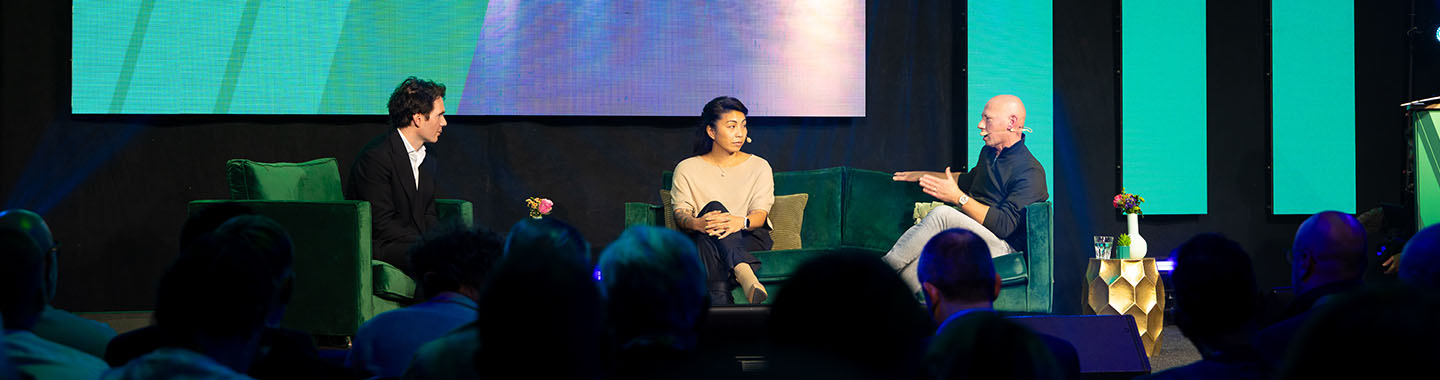
During NEXT 2026, Jürgen explained how Shimano is therefore increasingly opting for standardisation and a smaller number of partners capable of overseeing multiple aspects of the IT landscape. Bechtle is one such IT partner. Not as a supplier of a single solution, but as a partner for issues ranging from the workplace and the cloud to security, AV, software and procurement.
Above all, IT must not become unnecessarily complicated.
Shimano is an international organisation with Japanese roots. This means that some IT decisions are made at a global level, whilst within the European organisation there is also scope to choose solutions that are better suited to local circumstances. Jürgen’s view on IT is characterised by a down-to-earth Brabant approach: above all, it must be as simple and straightforward as possible.
That sounds obvious, but reality often tells a different story. There’s a specialist for every issue, a supplier for every product, and every new development may well bring yet another party into the mix. They may all be good at their own specific area, but someone then has to piece those puzzle pieces together.
That is precisely where Shimano wanted to gain more control. Not by concentrating all the expertise within a single organisation, but by making more conscious choices about which partners can support a broader part of the organisation. “Working with a single organisation is a lot easier than working with 25 different organisations, each doing their own bit,” Jürgen explained during NEXT.
From a one-off supplier to a comprehensive IT partner.
This philosophy is reflected in the partnership with Bechtle. Over the past two years, the scope of the collaboration has continued to expand. For example, we are working with Shimano on a workplace project, a data centre strategy and further international standardisation, amongst other things. Microsoft Intune was implemented in collaboration with PQR, and for international logistics they are working with ARP.
Jürgen: “That broad scope is not an end in itself. The value of working with an IT partner such as Bechtle lies precisely in the coherence between all those decisions.”

IT isn’t made up of separate pieces of a jigsaw puzzle.
After all, a new laptop roll-out isn’t just about hardware. You also have to deal with device management, security, logistics, support, lifecycle management and financing. Choosing a cloud solution, in turn, has implications for architecture, costs and management. When selecting a new security solution, you must also consider the network that colleagues rely on every day.
The idea that IT must function as a single, integrated whole aligns with what we at Bechtle call the connected workplace. An IT landscape in which workspace, networking, security, the data centre and cloud, software and services reinforce one another rather than functioning as isolated silos.
At Shimano, we see how this translates into practice. Not because every component must, by definition, be provided by the same partner, but because decisions in one area increasingly have consequences for another. “It helps if a partner looks beyond the project currently on the table,” said Jürgen. “If you want to roll out new laptops, you also need to consider how devices are configured, delivered internationally, managed throughout their lifecycle and ultimately replaced.”
That is precisely where you notice the difference between a supplier who delivers a product and an IT partner who understands how that product becomes part of the bigger picture.
Fewer suppliers does not mean less control.
A logical question raised during NEXT was therefore: aren’t you creating a new dependency by outsourcing more and more to a smaller number of partners? Jürgen recognised that risk. Shimano therefore does not blindly opt for a single provider. “We continue to benchmark, compare alternatives and critically assess what a partner must be able to deliver.”
According to Jürgen, that is an important nuance. ‘Taking the pressure off’ does not mean that, as an IT organisation, you relinquish control. On the contrary, it means that you make more conscious decisions about where you want to add value yourself and where a partner can take work off your hands.
Sometimes a particular issue requires a specialist, and sometimes it is wiser to entrust several issues to a partner with a broader remit. The trick is not to think in terms of individual products, but in terms of what your organisation needs.
Make a conscious decision about which expertise you want to keep in-house and look for partners who can see beyond their own area of specialism.
Jürgen Slaats, IT-manager Shimano Nederland
The benefit is also in terms of time.
For Jürgen, one benefit of this is very tangible: time. “By streamlining and standardising the supplier landscape, we need less time to coordinate everything around it.” And it is precisely that time that is in short supply within IT.
Every contract negotiation, every handover between suppliers and every discussion about who is responsible for what demands the attention of people who are, in the meantime, also dealing with security, the cloud, workplace modernisation, AI and the next request from your business.
Jürgen: “A good IT partner doesn’t simply take on that work. They need to know the organisation, understand where it wants to go, and also have the courage to suggest when a different route makes more sense.”
The need for a strong partnership proved to be a common theme amongst several organisations at NEXT.
- In the poll of visitors, 57.3% stated that they primarily expect a high level of partnership, quality and strategic advice from an IT supplier, even if this means paying a little more.
- A further 31.5% prefer a comprehensive IT partner who takes as much off their hands as possible. Not because IT organisations want less control, but because control does not mean you have to carry out everything yourself.
What role does your IT department wish to retain?
The collaboration between Shimano and Bechtle is still very much a work in progress. New issues relating to the cloud, architecture, networking, AI and the workplace are already on the agenda. But the underlying principle remains the same: IT must remain manageable, with standardisation wherever possible. Jürgens’ advice: “Make a conscious choice about which expertise you want to retain in-house and seek out partners who can look beyond their own area of specialism.”
Perhaps that is why this is also the most interesting question for other IT organisations. Not “how many suppliers do we have?”, but “how much time and attention does it take us to get all those suppliers to work together to form a single, well-functioning IT landscape?”. If the answer is “too much”, the solution may not lie in collaborating with yet another IT partner.
Would you like to spend less time managing batches?
Would you like to explore where your IT landscape could be organised more simply and which components you could cleverly consolidate with a single partner? Our specialists would be happy to help you explore the options.