lindy colour
Charge efficiently. Connect with confidence.

USB-C charging solutions from Lindy:
chargers, charging stations and cables.

Reliable USB-C power delivery.

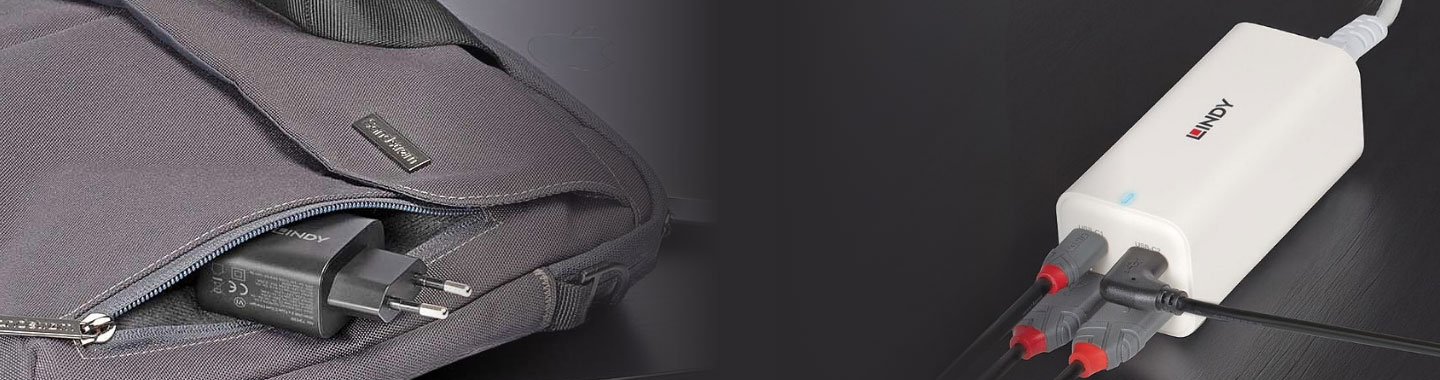
GaN chargers, multi-port charging stations and high-performance USB-C cables from Lindy designed for modern offices, meeting rooms and mobile teams. Available from Bechtle.

Power delivery as part of your IT infrastructure.

USB-C Power Delivery has become the universal charging standard, from smartphones to laptops. Lindy offers charging solutions designed for professional, everyday use, combining compact GaN technology with intelligent power distribution for efficient multi-device charging.

Whether for individual workstations, training rooms or mobile employees, Lindy helps you create a consistent charging infrastructure tailored to your device portfolio.
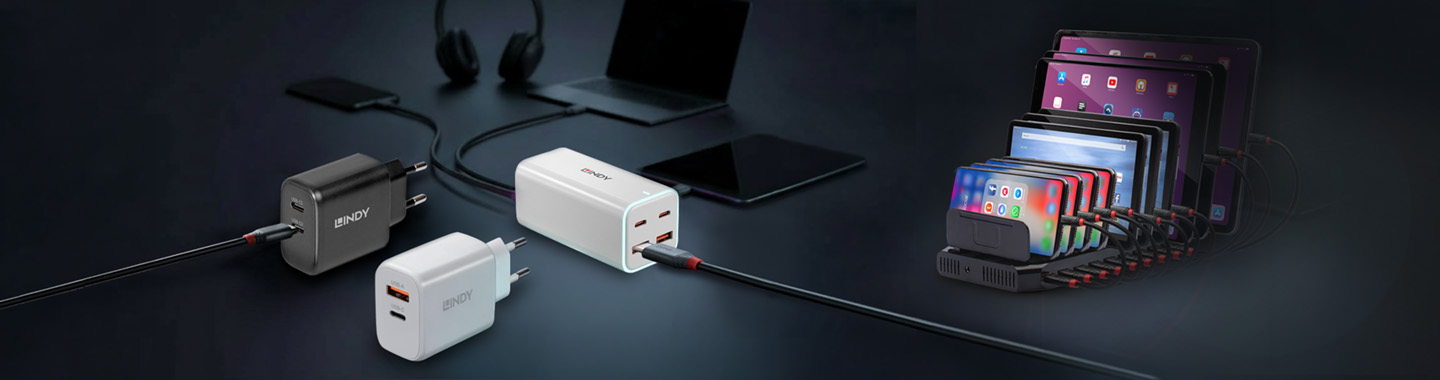
How to charge laptops, smartphones and tablets via USB-C.

GaN technology.

Up to 50% smaller than silicon-based power supplies with the same power output.

Compliance and documentation.

RoHS & REACH compliant. Verified supply chain. Compliance without added complexity.

Multi-device charging.

Charge multiple devices simultaneously, without the need for power strips.

B2B quality.

Made for Professionals. Lindy has been serving the IT industry since 1932.

GaN chargers with 30, 65 and 100 W.

Compact USB-C Power Delivery chargers built on advanced gallium nitride (GaN) semiconductor technology. From smartphone charging to laptop power, one standard for all your devices.

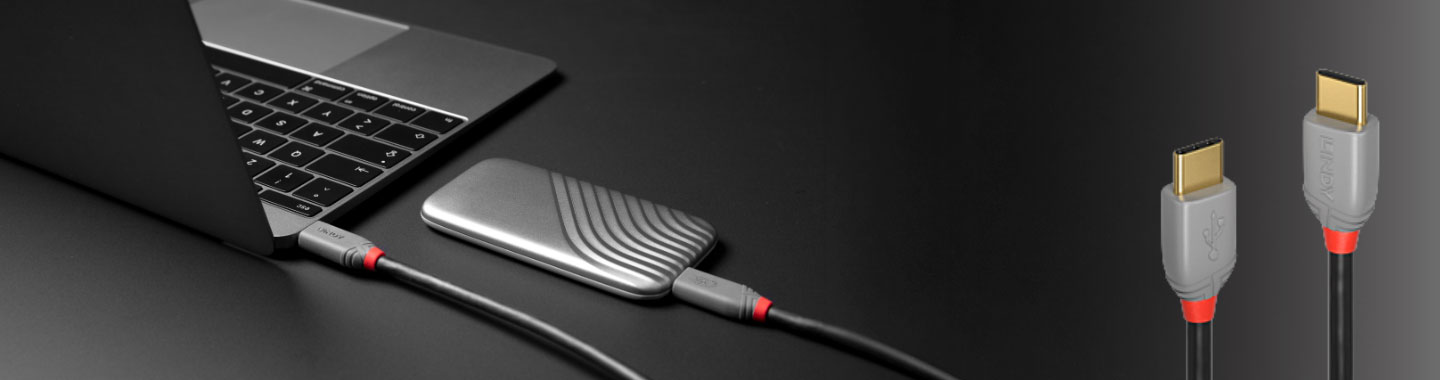
USB-C cable with up to 240 W and 40 Gbit/s.

Supporting Power Delivery from 60 W to 240 W and speeds of up to 40 Gb/s, these cables enable fast, reliable data transfer. Lindy USB-C cables are designed for demanding AV and IT applications.

USB 2.0, USB 3.2 and USB 4 compared.

Standard

Data

Power Delivery

Best for

USB 2.0

480 Mb/s

Up to 60 W

Charging, mobile devices

USB 3.2 Gen 2x2

20 Gb/s

Up to 100 W (with E-Marker)

Docks, external SSDs

USB 4

40 Gb/s

Up to 240 W (with E-Marker)

Workstations, 8K displays

6-port USB charging station with 160 W for meeting rooms and hot desks.

Three USB-A and three USB-C ports, intelligent power distribution (Smart Charging) and 160 W total power output.

One USB-C port delivers up to 140 W (PD 3.1) for larger laptops, while two additional ports provide up to 30 W each (PD 3.0). Ideal for meeting rooms, training environments, reception areas and hot-desking workspaces.

6 ports

3 x USB-A, 3 x USB-C

160 W

Total power output

140 W

Via a single USB-C port

Place the charging station here.

Conference room.

Training room.

Reception and lobby.

Hot-desking.

Manufacturer no.: 
Article no.: 
    Manufacturer no.: 
    Article no.: 
      Manufacturer no.: 
      Article no.: 
        The right USB-C charging solution for your needs.

        Discover USB-C chargers, charging stations and cables from Lindy in the Bechtle online shop.

        Noah Mayer
        Noah Mayer
        Product Manager

        Frequently asked questions about USB-C chargers, charging stations and cables.

        What is USB-C Power Delivery (PD)?
        How much power does my laptop need?
        What is the difference between USB 2.0, USB 3.2 and USB4 cables?
        What is an e-marker chip and why is it important?
        What is GaN and what are its benefits?
        What is USB-C Power Delivery (PD)?

        USB Power Delivery is the standard that allows USB-C devices to automatically determine the appropriate power level, from just a few watts for smartphones to up to 240 W for high-performance workstations. The charger, cable and device automatically ensure that the highest supported power level is delivered safely.

        How much power does my laptop need?

        As a general rule, 30 W is sufficient for smartphones and tablets, 65 W for ultrabooks and laptops, and 100 W for workstations. Always refer to the laptop manufacturer’s specifications. Using a higher-rated charger will not harm the device, as it only draws the power it requires.

        What is the difference between USB 2.0, USB 3.2 and USB4 cables?

        The main difference lies in data transfer speeds. USB 2.0 supports up to 480 Mb/s, USB 3.2 Gen 2x2 delivers up to 20 Gb/s for docking stations and external SSDs, while USB4 supports speeds of up to 40 Gb/s for workstations and 8K displays. Depending on the cable, Power Delivery ranges from 60 W to 240 W.

        What is an e-marker chip and why is it important?

        An e-marker is a chip built into the cable that enables connected devices to identify its capabilities, including the maximum supported charging power. It is required for USB Power Delivery above 60 W

        and all compatible Lindy USB-C cables are equipped with one.

        What is GaN and what are its benefits?

        GaN (gallium nitride) is a semiconductor technology that switches more efficiently than traditional silicon. As a result, chargers generate less heat and can be up to 50% smaller while delivering the same power output, reducing the space required on desks and making them easier to carry.