
Desktop as a Service.
In the second episode of Hip or Happening?, Tom Jessen, Dirk van de Werdt, Business Developer at Bechtle, and Remco de Kramer, Go-To-Market Lead at Microsoft, explored the current state of Desktop as a Service. One thing quickly became clear: Desktop as a Service is no longer just a discussion about cloud PCs.
Desktop as a Service delivers the entire workplace through a cloud-based environment. Rather than focusing on a single application or simply modern device management, it provides the complete desktop experience employees rely on every day. Understanding that distinction is important, as the terminology is still frequently used interchangeably.
Desktop as a Service is not the same as Device as a Service (DaaS), nor does it resemble a traditional virtual desktop environment that you build, manage and deliver yourself. As Dirk put it in the podcast: “When we talk about Desktop as a Service, we’re talking about delivering the complete workplace from the cloud. The real difference lies in how it’s consumed and deployed.”
Rather than investing in complex infrastructure or building specialist expertise in-house, organisations can adopt Desktop as a Service through a subscription model and scale it up or down as requirements change. That flexibility makes it easier to adopt while also elevating it from a technology choice to a strategic workplace decision.
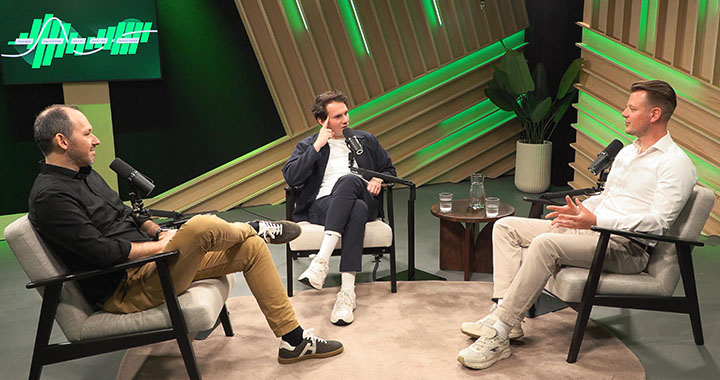
The strongest argument in favour of Desktop as a Service is its flexibility. As Remco explains: “It’s particularly relevant for organisations that rely on temporary staff, consultants, seasonal workers or large numbers of shared workstations. It’s equally valuable for businesses growing through acquisitions and looking to give new teams fast access to a secure working environment without having to rebuild every device from scratch.”
In scenarios like these, Desktop as a Service can significantly accelerate deployment. New users can get up and running more quickly, organisations can reduce upfront infrastructure investments and capacity can be scaled back just as easily when requirements change.
“That’s also where the nuance comes in,” Dirk points out. “Desktop as a Service isn’t automatically the right fit for every employee, every application or every organisation. For most businesses, it’s unlikely to be an all-or-nothing decision. Some employees may continue working on a modern, locally managed laptop, while others are better served by a cloud-based desktop. In certain situations, factors such as security or rapid onboarding may carry greater weight.”
The real question, then, isn’t whether Desktop as a Service can be implemented, but where it delivers the greatest value in practice.
Desktop as a Service is often treated as an IT initiative, which is hardly surprising given its impact on workplace management, infrastructure, security and applications. Dirk believes that perspective misses the bigger picture: “This is a boardroom discussion. It’s not an IT issue, it’s an organisational issue.” That distinction matters because Desktop as a Service changes far more than the location of the desktop. It reshapes how organisations deliver, fund, govern and scale IT, making it as much a business decision as a technology one.
- For CFOs, the conversation centres on CAPEX and OPEX. Upfront infrastructure investments give way to predictable per-user subscription costs, creating greater flexibility while requiring a different approach to budgeting, forecasting and cost control.
- For CEOs, the discussion is about focus. Which activities create competitive advantage and should remain in-house? Which can be entrusted to a specialist partner? And how should the organisation evolve when IT spends less time managing infrastructure and more time enabling the business?
- For security and compliance leaders, control becomes the key consideration. Where is your data stored? Who can access it? How is continuity ensured? And what does increased dependence on cloud platforms, internet connectivity and external providers mean for the organisation’s overall risk profile?
“Interestingly, the biggest challenge isn’t necessarily the technology,” says Remco. “The capabilities are there, the delivery models have matured, and solutions such as Windows 365 have made cloud desktops far easier to adopt and manage.”
Easier deployment, however, doesn’t make the decision itself any simpler. Desktop as a Service comes with clear trade-offs that organisations need to weigh carefully. In return for greater standardisation, scalability and speed, organisations often give up a degree of flexibility. Some traditional environments allow for a level of customisation that isn’t always available in a cloud-delivered model. Dependence on the chosen platform also increases, and moving away from it later may require another significant strategic decision.
For many organisations, the journey to Desktop as a Service is therefore more complex than the technology itself. Success depends on having a clear understanding of your requirements, the compromises you’re willing to accept, and the impact those choices will have on architecture, security, processes and governance. As Dirk puts it: “The technology is mature enough. The real challenge lies with people. A technology may be ready for adoption long before an organisation is ready to embrace it.”
Desktop as a Service only becomes relevant once you’re clear about the problem you’re trying to solve. Perhaps onboarding takes too long, IT spends so much time managing the workplace that innovation takes a back seat, or growth, acquisitions and temporary teams repeatedly create new workplace challenges. In situations like these, Desktop as a Service can offer a more flexible way forward.
Security is another common driver. Organisations looking to keep sensitive data off local devices may find that a cloud-based workplace provides greater control and consistency. It can also help employees stay productive when devices are lost or damaged, or when secure access needs to be provided at short notice. Even then, the most important question remains unchanged: does the solution fit the way your organisation actually works?
As Dirk explains: “The connected workplace isn’t about moving as much technology as possible to the cloud. It’s about creating alignment. Between the workplace, network, security, applications, management, users and policies. Desktop as a Service can play an important role, but only when it forms part of a deliberate workplace strategy.”
It’s tempting to evaluate Desktop as a Service purely as a technology decision. Is it fast enough? Secure enough? More cost-effective than the current setup? All are valid questions, but they risk distracting from the bigger issue if you haven’t first defined what you’re trying to achieve as an organisation.
Start by answering a different set of questions:
- How do you want to deliver the workplace in the future?
- What level of standardisation makes sense for your organisation?
- Where would greater flexibility create the most value?
- Which management burdens are you trying to reduce?
- Which dependencies are you willing to accept?
- Which stakeholders need to be involved from the outset?
Only then can you determine whether Desktop as a Service is the right fit for a specific group of employees, a particular use case, international expansion or perhaps, over time, a larger part of the organisation. Not because the technology makes it possible, but because it supports the direction your organisation wants to take.
Ask yourself one final question: If you were designing your workplace strategy from scratch tomorrow, would you see Desktop as a Service as an IT solution, or as a strategic decision about how your organisation wants to work, grow and evolve?
In the latest episode of Hip or happening?, Tom Jessen, Dirk van de Werdt and Remco de Kramer take a closer look at Desktop as a Service. Where does the technology stand today? Which of its promises have already been realised? And which questions should organisations still be asking before taking the next step? You’ll find the answers in the episode.
Can Desktop as a Service help make workspaces more flexible, secure and easier to manage? And is it a discussion that belongs in the boardroom rather than the server room? In the second episode of Hip or Happening?, host Tom Jessen joined Dirk van de Werdt (Bechtle) and Remco de Kramer (Microsoft) to explore the topic. As organisations contend with temporary teams, growing demands for agility, evolving security requirements and geopolitical uncertainty, Desktop as a Service is proving more relevant than ever.
Not sure whether Desktop as a Service is the right fit? Explore our guide to discover where it adds value, which challenges it can help solve and what to consider before taking the next step.