Hip of happening? | Everyday AI.
AI is allang geen speeltje meer voor een kleine groep IT-enthousiastelingen. De meeste organisaties hebben inmiddels wel iets getest met ChatGPT, Microsoft Copilot of andere AI-tools. Toch merken we dat bij veel klanten dezelfde vraag blijft hangen: wat levert AI nu eigenlijk echt op? Want echte waarde ontstaat pas als medewerkers begrijpen wat AI wel en niet kan, als data op orde is en als AI veilig, verantwoord en doelgericht wordt gebruikt op de werkvloer.
In the third episode of Hip or Happening?, host Tom Jessen joins AI entrepreneur and technology speaker Jim Stolze and Kees Janssen, Manager Modern Work Solutions at Bechtle, to explore the current state of Everyday AI, quickly revealing that AI only becomes more than a helpful assistant when adoption, governance and data management are firmly in place.
Everyday AI is about bringing AI into the flow of everyday work, not simply as a chatbot you occasionally consult, but as technology that actively supports employees in their daily tasks and processes. Whether it’s finding information more quickly, summarising documents, developing proposals, preparing for customer conversations or streamlining repetitive tasks, the goal is to make everyday work easier and more effective.
In the podcast, Kees compares AI to the widespread move to the cloud a decade ago. Everybody was talking about it, yet there was often little agreement about what “moving to the cloud” actually meant in practice. The same thing is happening with AI today. As Kees puts it: “I think everyone is already using AI in some form. The real questions are: what are you using, where are you using it, and how are you putting it to work?”
Those questions matter, because organisations that view AI as just another tool can easily overlook its wider impact. Everyday AI isn’t about a single application. It’s about how AI becomes embedded in the way work gets done, shaping processes, information flows and decision-making across the organisation.
According to Jim, the initial sense of fascination has largely worn off. “The novelty has started to wear off. We have a reasonable idea of what AI can do, but it becomes far more interesting once people are allowed to use it as part of their day-to-day work.”
That shift is significant, because AI is no longer something people simply experiment with. They want to use it as part of their everyday work to:
- find information more quickly
- spend less time on manual tasks
- make better use of the knowledge that already exists within the organisation.
None of that happens automatically. Many employees still use AI much like a search engine: question in, answer out. That’s understandable, but it only scratches the surface of what’s possible. As Jim explains: The real value only emerges when AI has access to the right context, whether that’s documents in SharePoint, project information, customer data or internal knowledge.” At that point, AI moves beyond providing generic answers and starts delivering support that is genuinely relevant to the work people need to do.
That’s why AI literacy is becoming increasingly important. Not as a box-ticking exercise or a one-off training session, but as a fundamental requirement for using AI effectively across the organisation. Employees need to understand not only what AI can do, but also where its limitations lie.
As Jim puts it: “AI isn’t magic. At its core, it’s mathematical and built on historical data.” That means AI can produce impressive results, but it can also make mistakes, hallucinate or reinforce existing biases. Without that understanding, AI quickly becomes a risk. Employees may place too much trust in inaccurate outputs or share sensitive information in situations where they shouldn’t.
Others may expect AI to fix a process when the underlying data or way of working still isn't fit for purpose. Building AI literacy helps reduce those risks. Not by making people wary of AI, but by giving them the knowledge and confidence to use it responsibly.
As Kees points out, “Many people equate AI adoption with giving employees access to a tool. But purchasing a licence isn’t the same as adoption.” In the podcast, he explains that the real benefits only begin to emerge once the right foundations are in place, because understanding AI is only the first step. Employees also need to know how to apply it effectively in their own work and processes.
That requires much more than a brief introduction.
- Which processes are well suited to AI?
- Where can AI save time?
- Where can AI improve quality?
- Where do new risks emerge?
- How do you prevent employees from experimenting independently with disconnected AI tools?
AI may be one of the first technologies employees actively ask for. They see colleagues benefiting from new tools and want access to them as well. That’s a positive development, but it can also lead to fragmentation if left unmanaged. Without clear guidance, organisations can quickly find themselves dealing with shadow IT, or in this case, shadow AI.
A good AI policy doesn’t just tell people what they can’t do. It also shows them what they should do.
Jim Stolze, AI entrepreneur and technology speaker
Shadow IT rarely emerges because employees deliberately want to work irresponsibly. More often, it develops when people have a genuine need for certain tools and capabilities, but the organisation hasn’t yet provided a clear and practical alternative.
That’s why governance matters. But effective governance is about far more than maintaining a list of prohibited apps and tools. As Jim puts it: “A good AI policy doesn’t just tell people what they can’t do. It also shows them what they should do.” Organisations still need to define which tools may be used, which data require protection and which use cases carry unacceptable levels of risk.
Good AI governance should also provide direction. Ask yourself:
- What are we trying to achieve with AI?
- Where do we want people to use it?
- How does it help employees do their jobs more effectively?
- How do we ensure AI supports the organisation’s objectives?
If all you do is tell people what they can’t do, they’ll find workarounds. Make it clear what they can do, and AI adoption becomes both safer and more effective.
Adoption matters, but data governance matters just as much—perhaps even more.
Kees Janssen, Manager Modern Work Solutions at Bechtle
Alongside adoption, data governance is one of the most important factors in successful AI implementation. After all, AI can only deliver meaningful value when it’s clear which data it can access and use. As Kees puts it: “Adoption matters, but data governance matters just as much—perhaps even more.”
For many organisations, that remains a significant challenge. They possess vast amounts of data, but often lack a clear overview of what is stored where, who has access to it and which information is sensitive. Without the right controls, introducing AI into that environment can create unnecessary risks. Confidential documents, payroll information, customer data and strategic plans all require careful handling.
Organisations therefore need to decide which data AI should be allowed to use, which information must never leave the organisation, and which safeguards need to be put in place. Employees also need to understand why those measures matter and how they support responsible AI use. Data quality and data classification are not issues to address at a later stage. They determine from the outset whether AI can be used safely, effectively and with confidence.
Many conversations about AI start with productivity gains. That’s understandable, as AI can help employees summarise, write, research and prepare more efficiently. But if you judge AI solely by the time it saves, you risk missing the bigger picture. In the episode, Kees poses an important question: should AI always be viewed through the lens of cost savings?
After all, time saved can be reinvested in better customer engagement, more informed decision-making, new propositions or work that previously never made it to the top of the priority list. The real business value lies not just in working more efficiently, but in what you choose to do with the time you gain.
AI becomes truly valuable when you’re clear from the outset about the problem you’re trying to solve. Do you want to:
- give employees more time?
- accelerate processes?
- make knowledge easier to access?
- improve quality?
- unlock opportunities that previously weren’t possible?
Start with the outcome you want to achieve, not the AI tool itself.
Many AI conversations start with the promise of saving time. That’s hardly surprising, given how effectively AI can help employees summarise, write, research and prepare. But focusing solely on minutes saved risks overlooking the bigger opportunity. Everyday AI requires experimentation. And as with any form of experimentation, not every initiative will deliver the expected results. As Jim explains: “That doesn’t matter. An experiment can’t really fail if you learn something from it.” There is an important caveat, however: experimentation without direction is something entirely different.
- Start small, with clearly defined use cases and clear ground rules.
- Focus on processes where AI can deliver measurable value.
- Make sure employees understand what they're doing and why as they experiment.
- Put strong data governance in place from the outset.
- Define clear ownership for governance, adoption, maintenance and evaluation.
This helps prevent AI from becoming a collection of disconnected initiatives and creates a clear path from experimentation to lasting value. Not because AI is new, but because it helps move your organisation forward.
Ask yourself one final question: Are your employees using AI primarily as a useful standalone tool, or do you already have the knowledge, governance and adoption strategy needed to turn it into lasting value?
In the latest episode of Hip or happening?, Tom Jessen, Jim Stolze and Kees Janssen take a closer look at Everyday AI through the lens of the Bechtle Beat. Where does the technology stand today? Which of its promises are already delivering tangible results? And where should organisations still take a critical look before moving forward? You’ll hear their conclusions in the episode.
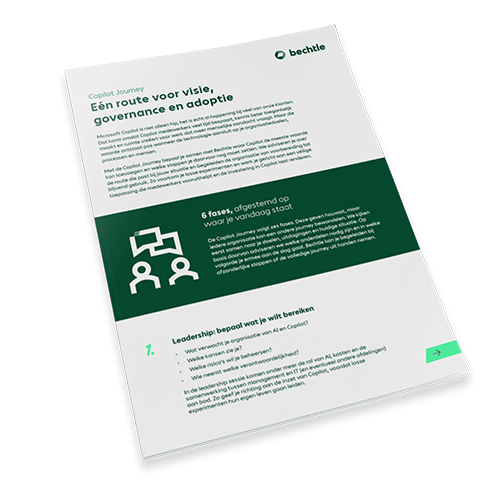
Chances are your organisation is already using AI tools such as Microsoft Copilot. But how do you turn AI into more than just a helpful tool for individual tasks? With the Copilot Journey, Bechtle helps you build towards secure, effective and future-ready use of Copilot. From strategy, governance and security to adoption, use cases and lasting value across the organisation.
Want to understand where your organisation stands today and what the next logical step looks like? Book a no-obligation call with Stefan Hems, Solution Consultant at Bechtle.