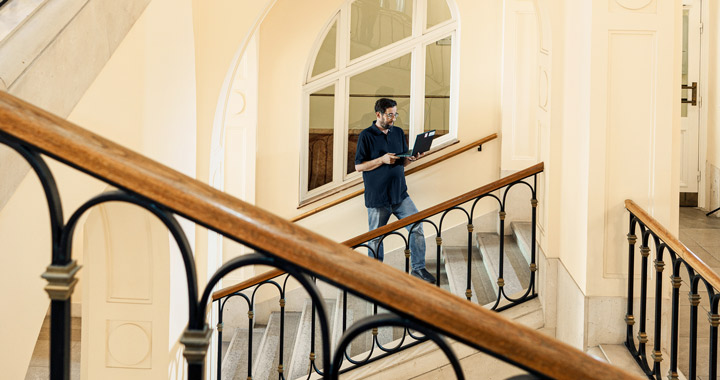
Person using laptop while walking on stairs inside a bright historic building

“That’s how we’ve always done it.” It is a phrase René Pranz knows only too well after more than 20 years in the Austrian civil service, where he works as an IT manager at the Austrian Federal Ministry for Economic Affairs, Energy and Tourism (BMWET). When it comes to artificial intelligence, however, waiting on the sidelines is not an option. “AI is here to stay, and we need to learn how to use it.” The benefits of AI and publicly available tools such as ChatGPT and translation services are becoming increasingly familiar to employees across government organisations. For public administration, however, their uncontrolled use raises important questions around data protection, confidentiality and traceability, all of which are fundamental requirements rather than optional considerations. Rather than leaving the use of AI to chance, René Pranz wanted to provide employees with an official, secure platform that would allow them to use AI confidently in their day-to-day work.


Image: Rene Pranz, IT Manager, Austrian Federal Ministry for Economy, Energy and Tourism

At a glance.

  • Topic: Artificial intelligence in the public sector
  • Use case: Secure AI portal for an Austrian federal ministry
  • Partners: Bechtle Austria and Smartpoint
  • Technology platform: Microsoft Azure
  • Focus: Data protection, governance and controlled AI usage
  • Benefits: Faster administrative processes and easier access to AI capabilities
  • Features: Model can be extended to other public-sector organisations
Two people in an office collaborating at computers focusing on screen content and teamwork

Central AI portal for ministry employees.

This thinking led to the development of a new, more comprehensive AI portal. At its core is KIRA, the ministry’s AI-powered assistant, which provides access to chat and language models alongside additional capabilities such as document summarisation, transcription, translation and image generation. As René Pranz explains: “What mattered most to me was having a one-stop shop—a single portal where employees can use AI with confidence, without having to worry about data protection requirements every time they process information.”

To turn the concept into a robust solution, the ministry sought partners capable of combining public-sector expertise, cloud technology and application development know-how, and it found them in Bechtle Austria and Smartpoint, a specialist in digital application solutions that has been part of the Bechtle Group since 2017. “Having worked with Bechtle for almost eight years, I’ve always been impressed by the team’s commitment, speed and expertise,” says René Pranz.
Security by design.

For the AI project, Bechtle provided the technical and organisational foundations, including the Azure environment, landing zone, security and governance framework, licensing, procurement processes, and the operating and cost model. Smartpoint built on this foundation to develop the application, its customised user interface and the underlying workflows.

Built on Microsoft Azure, the portal operates within a controlled cloud environment rather than relying on publicly available consumer AI services. Each connected customer receives a dedicated Azure tenant, ensuring a logically separated environment in which data are neither used to train AI models nor retained permanently, while chat histories are automatically deleted when a session ends. What may initially seem unusual to users is in fact a deliberate element of the platform’s security architecture.

Developing the solution required a dedicated Data Protection Impact Assessment (DPIA) making it essential to address a range of technical, organisational and legal questions: What data are processed? Where are they stored? Who has access? Which safeguards prevent the unintended storage or disclosure of information? “Bechtle’s expertise was invaluable throughout this process,” says René Pranz. “The security-related and administrative configurations they implemented were what made the Data Protection Impact Assessment possible in the first place.”

Smartpoint, too, saw the security requirements not as an obstacle but as an integral part of the solution. René Pranz was particularly impressed by the team’s willingness to contribute its own ideas. “They came up with suggestions I would never have thought of myself,” he says. He was equally enthusiastic about Bechtle’s Azure expertise: “There’s a group of specialists there whose expertise is simply outstanding. I work in IT myself, but the level of knowledge they bring is remarkable.” Reflecting on the collaboration, he concludes: “We worked very effectively and efficiently, and had a good deal of fun along the way.”

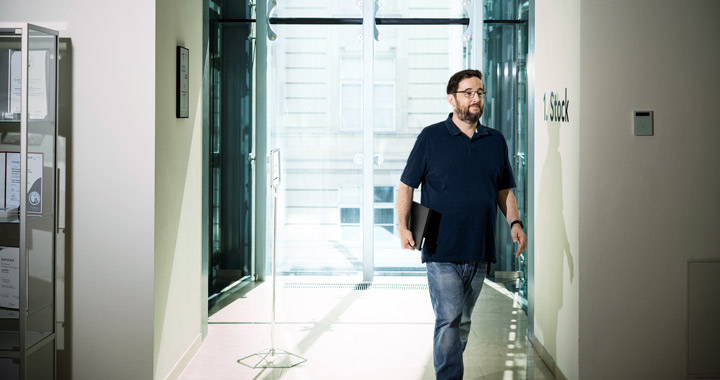
Man carrying laptop walking through bright hallway with large windows in modern work environment

How AI supports day-to-day administrative work.

Today, employees across the ministry use the portal to summarise documents, transcribe audio and video recordings, translate content, draft and structure texts, and generate images. According to René Pranz, transcription is one of the most valuable use cases: “Meetings often run for hours, and their contents need to be documented, analysed and followed up on. AI also makes it much easier to work through studies, reports and documents from a wide range of organisations.”

For Pranz, the value of AI lies not in replacing people, but in making administrative work easier while helping employees develop new skills. “At its core, it’s about simplification,” he says. To unlock that potential, however, employees need to be able to use AI naturally and confidently in their day-to-day work.

Meetings often run for hours, and their contents need to be documented, analysed and followed up on. AI also makes it much easier to work through studies, reports and documents from a wide range of organisations.

René Pranz


A blueprint for AI in the public sector.

Keeping costs transparent was an important part of the concept from the outset. Each employee receives a budget for using the AI applications, with the portal displaying both the cost of individual interactions and the remaining balance. According to René Pranz, the objective is less about control than awareness: “I think it’s useful to have that information visible because it reminds people that these services actually come at a cost.”

The platform developed by Bechtle and Smartpoint was also designed to grow beyond a single use case. New applications can be added, existing functions adapted and permissions managed centrally, making the solution attractive to other public-sector organisations. The Austrian Federal Ministry of Education is already using the platform, while other ministries and organisations have expressed interest. A key prerequisite was an administrative cooperation agreement that René Pranz put in place at an early stage, creating the framework for multiple ministries—and potentially other public institutions—to share the solution without having to develop their own versions.

What began at the Austrian Federal Ministry for Economic Affairs, Energy and Tourism has since evolved into a model for the effective use of AI across the public sector without compromising security, data protection or oversight. The project’s success reflects the commitment of René Pranz and the ministry’s leadership team, who recognised the opportunities presented by AI early on and, together with their partners, built a robust platform for using AI.

Its impact extends far beyond the project itself. Most importantly, employees can now use AI securely and as a natural part of their daily work. And perhaps one day, even in public administration, the reaction to working with AI will simply be: “We’ve been doing that for years.”

results by Bechtle.

This article is an excerpt from the current print edition of results by Bechtle.

Please note that the magazine is only published in German.