
Two people of different ages looking relaxed into the distance with a landscape at sunset

A fresh breeze sweeps across the landscape. On the horizon, wind turbine blades turn steadily, generating renewable electricity. Yet even wind power has a sustainability challenge. Most rotor blades are made from glass fibre-reinforced composites, built up from layers of fibreglass fabric and carbon fibre bonded with resin in an energy-intensive manufacturing process. The blades are designed to last for decades, but not forever. Once retired, recycling them is often too complex and costly, leaving shredding and incineration as the most common options. As a result, the generation of clean electricity comes with a growing waste problem. Tom Siekmann has been thinking about a better alternative for years. His family has long been involved in the wind energy sector. “Even my father wondered whether rotor blades could be made from wood,” he says. For a long time, that vision remained just that. Today, advances in materials, manufacturing technology and engineering software have made it a realistic proposition. Convinced the time was right, Siekmann joined forces with Joachim Knapp and an experienced rotor blade designer to found Voodin Blade Technology in 2021.

Image: Voodin Blade Technology co-founders Tom Siekmann (left) and Joachim Knapp. Knapp is also Managing Director of Anker-Tec.
At a glance.

  • Focus: More sustainable wind power through wooden rotor blades as an alternative to conventional glass fibre-reinforced composite designs.

  • Challenge: Conventional wind turbine rotor blades are difficult to recycle at the end of their service life.

  • Solution: Voodin Blade Technology is developing wooden rotor blades for a more sustainable approach to wind turbine design.

  • Bechtle PLM’s role: Providing and integrating the cloud-based 3DEXPERIENCE platform and SOLIDWORKS to support development, collaboration and product data management.

  • Outcome: A first wooden rotor blade has been in operation since 2024. The next step is the development of solutions for large multi-megawatt wind turbines.

Two people in workshop inspecting and working on a large curved wooden component for industrial use

From concept to prototype.

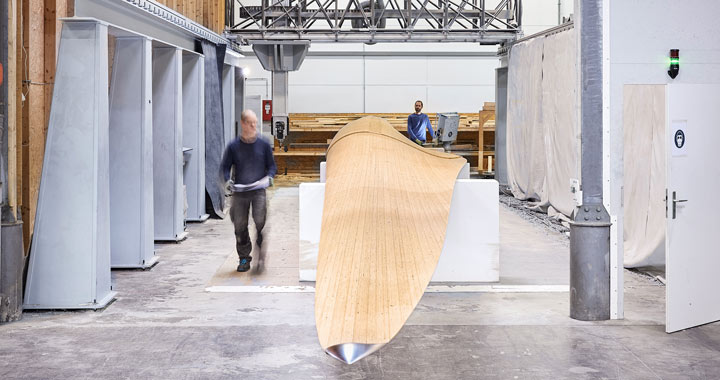
Joachim Knapp is pursuing the venture alongside his role as Managing Director of Anker-Tec, a manufacturer of large CNC milling machines with extensive expertise in advanced production technologies. Voodin Blade’s team is spread across Europe, with Tom Siekmann based in central Germany, Joachim Knapp in the far north of the country, and engineering specialists working from locations across the continent. What connects them is a shared digital platform: 3DEXPERIENCE for data management, collaboration and process management, combined with SOLIDWORKS for engineering and design. The partners’ first proof of concept was straightforward: replace the existing rotor blades on one of Siekmann’s wind turbines with wooden ones. The original blade geometry was retained, with the material being the only fundamental change.

Image: The first 20-metre rotor blades are being produced at Anker-Tec’s demonstration centre. The next step: 40-metre blades and a dedicated manufacturing facility.
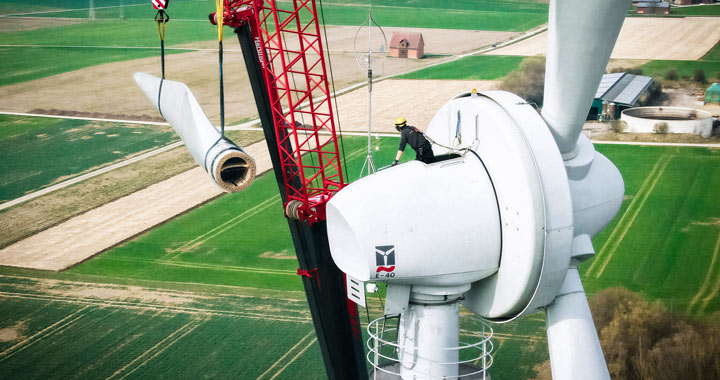
Technician installs rotor blade on wind turbine using crane in rural setting

Knapp explains the process: “We digitally sliced the blade model into 50 mm cross-sections and milled each one from timber panels. Similar to 3D printing, we build up the blade layer by layer.” SOLIDWORKS provides the manufacturing data for the large gantry milling machine. The individual sections are assembled by hand to create an initial, still rough-edged blank. Once the adhesive has cured, the blade is machined again to achieve its final aerodynamic form. The finishing touches include lightning protection and the final coating. Knapp has extensive experience manufacturing large, complex components. “The work starts on the computer long before the first piece of timber is machined,” he says. The challenge is to consider design and manufacturing together from the outset. After all, even the most aerodynamically efficient blade geometry is of little use if no machine can produce it.

Image: Proof of concept, 2024: the first wooden rotor blades are installed on an existing wind turbine.
Cloud-based collaboration.

Coordinating a team spread across Europe would be difficult without a shared digital environment. For Voodin Blade, that environment is 3DEXPERIENCE, Dassault Systèmes' platform for product lifecycle management, combined with SOLIDWORKS for design and engineering. The software had already been in use at Anker-Tec for many years, with Bechtle PLM supporting its implementation and ongoing development. “We’ve used the software successfully at Anker-Tec for years, so it was an obvious choice for Voodin Blade as well,” says Joachim Knapp. The team opted for 3DEXPERIENCE with SOLIDWORKS in part because its members are based in different locations. “Since we're not all working in the same place, it makes collaboration much easier,” says Knapp. “With support from Bechtle PLM, we also applied for Dassault Systèmes' SOLIDWORKS for Startups programme. We received approval straight away and were able to start using the software immediately.”

The rotor blade designer uses SOLIDWORKS to create the 3D model of the blade, but the software also plays a role in validating the design. Using integrated finite element analysis (FEA), it helps evaluate the blade’s aerodynamics, structural loads, stiffness and deformation behaviour. The manufacturing stage then takes place at Anker-Tec in Kiel, where the engineering team further develops the CAD models and prepares them for production and assembly.

From certification to market: The next step for wooden rotor blades.

Since 2024, Voodin Blade's wooden rotor blades have been turning in the wind. The milestone demonstrated not only that the blades can generate electricity, but also that the technology can meet the regulatory requirements needed for deployment. Bringing an entirely new rotor blade concept to market involves extensive certification and approval activities. SOLIDWORKS supports this work by making the required engineering data available directly from the development workflow. Following the successful deployment of its 20-metre rotor blade, the company is now working on a new concept for blades measuring 40 metres and beyond, intended for large multi-megawatt wind turbines. And can those be made from wood as well? “Yes,” says Tom Siekmann with a smile. “But we can’t reveal how just yet because our patent application is still pending.”

SOLIDWORKS also provides the engineering data needed for certification, regulatory approval and patent applications. Voodin Blade Technology has yet to sell its first rotor blade, but the company is already preparing for the next phase. Support from the EU Innovation Fund is helping to finance the transition from prototype development to commercial production. At the same time, the team continues to grow, with additional specialists joining in engineering, rotor blade design and manufacturing. “Our team is spread across Europe,” says Tom Siekmann. “That's why 3DEXPERIENCE remains our shared cloud-based development platform.” On the horizon, wind turbine blades continue to turn in the wind, though few are made from wood today. The founders of Voodin Blade are convinced that is about to change.

results by Bechtle.

This article is an excerpt from the current print edition of results by Bechtle.

Please note that the magazine is only published in German.