Dr Feiyu Xu: “Germany and the EU must compete to lead in AI.”
Feiyu Xu on open AI models, the responsibility of corporate leadership, and Europe’s opportunities in industry.
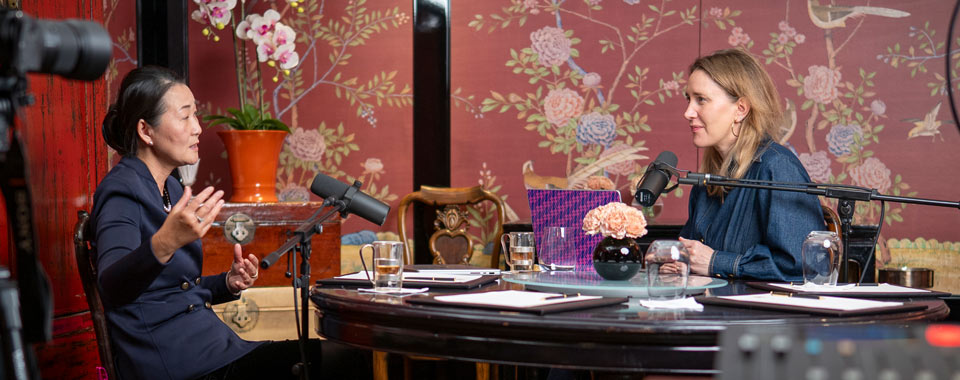
Dr Xu, you grew up in China, have lived in Germany since the early 1990s and consider yourself European. How do you view the great AI race between the United States and China?
Feiyu Xu: Before focusing solely on the United States, China or Europe, I think it’s important to recognise that we are in the midst of a new industrial revolution and to understand what that actually means. Driven by digitalisation and artificial intelligence, this revolution rests on a complex AI ecosystem that extends far beyond large language models and begins with something as fundamental as energy infrastructure. Without energy, there are no cloud platforms and no large language models. Then there is the competition around AI chips, most of which are designed by US companies and around 90% of which are manufactured in Taiwan. Europe and Germany certainly have outstanding companies such as ASML, Zeiss and Trumpf, but cloud infrastructure is another matter. Europe has relatively few hyperscalers compared with the United States and China, and the leading frontier models are also being developed primarily in those two countries. On top of that come the applications built along this entire value chain. That’s why I believe AI needs to be viewed in a broader historical context, with Europe’s position assessed within the wider framework of global competition.
You know both China and Europe exceptionally well. When it comes to AI, what do you think people in Germany still don’t fully appreciate about China?
Xu: I wouldn’t say we misunderstand China; rather, I think we don’t understand it well enough. Many people know the country only through news reports, social media or second-hand accounts. To appreciate the pace at which China is moving, you really need to experience it first-hand, which is why many organisations now arrange delegation visits so that executives can see the scale of innovation for themselves. I’ve lived in Germany for more than thirty years, but between 2017 and 2020 I returned to Beijing as Head of AI Lab and Vice President at Lenovo. It was a fascinating experience because, although I moved to Germany at a young age, I had never lived and worked in China as an adult. That gave me a very different perspective on the country and its development. People often say that the Chinese copy ideas, but I think that overlooks something important. Behind it lies a willingness to learn, improve and build on what already exists. After all, “Made in Germany” was not originally intended as a mark of quality. The label was introduced by the British to identify products from Germany, yet today it stands for quality and innovation. That is why I believe we need a more nuanced view of what people often describe as copying. Germany, too, should be more willing to learn from successful ideas elsewhere and adapt them to its own strengths, provided this happens fairly and transparently. Anyone visiting Shanghai today is likely to be struck by the pace of change. Thanks to the electrification of transport, the city feels remarkably quiet and clean. You might encounter a robot politely asking you to step aside because it is delivering food. Cities have become cleaner, more modern and greener, supported by extensive reforestation efforts. To understand China, you need to understand that combination of speed, openness to technology, willingness to learn and willingness to experiment. We do not misunderstand China; we need to get to know it again.
You moved from Lenovo in Beijing to SAP as Global Head of AI before AI entered the mainstream. What was it like driving AI adoption in a large organisation at a time when the technology was still a niche topic?
Xu: Having served as Vice President and Head of AI Lab at Lenovo, where I was responsible for the company’s overall AI strategy, the move was not entirely unfamiliar territory. While my role as SAP’s Global Head of AI extended beyond technology alone, I had already built Lenovo's central AI lab and AI team from the ground up, growing it from a small group of researchers and engineers to more than 400 people within just two years, which gives you a sense of the pace at which AI was developing at the time. What made that possible was strong support from the company’s leadership. The CEO and Chief Strategy Officer saw intelligent transformation as one of Lenovo’s most important strategic priorities, and during my first months in Beijing I worked with the Chief Strategy Officer almost every day on the company’s AI strategy. It’s worth remembering that, in 2016 and 2017, Germany was still some distance from embracing AI, whereas China had already begun treating it as a strategic priority. AlphaGo’s victory over the South Korean world champion in 2016 was a turning point because many people had believed AI would never outperform humans in a board game as complex as Go. China also defined its national AI strategy that year, which is why Lenovo invited me to Beijing to build its overall AI strategy. By then, AI was already one of the company's top strategic priorities and had moved well beyond niche status.
And what about SAP?
Xu: SAP was also an early adopter of AI. By the time I joined, the company already had a large central AI team in place. Defining an AI strategy for a global organisation was still an enormous challenge, particularly during the pandemic and in a largely virtual environment, although having Christian Klein champion the topic at CEO level was a real advantage. I worked very closely with the CEO, the CTO and the strategy team and was one of the few senior executives at SAP to develop a company-wide strategy within the first 100 days. At the time, people would say to me, “Fei, nobody else would have taken on that challenge.” Looking back, it was an incredible opportunity because developing the AI strategy so early on allowed me to get to know a large number of executives and team members in a very short space of time and quickly become part of the organisation. With the CEO’s backing, I also had immediate support across the business. Both Lenovo and SAP approached this in the right way because their leadership teams saw AI, transformation and AI strategy as their own responsibility. That’s how a new technology can gain traction so quickly in a large organisation. Ultimately, when we talk about AI, we’re not talking about a language model or a chatbot. We’re talking about the transformation of an entire company.
You joined the company from the outside and were tasked with driving a major strategic transformation. How did you deal with resistance along the way?
Xu: When I take on a role, I always ask myself how I can give more than 100 per cent to ensure that we develop a strategy not just with my team, but with the organisation as a whole, and one that people genuinely believe will move us forward. That requires extensive communication and a willingness to bring everyone along on the journey. Before joining Lenovo, I spent more than 19 years at the German Research Centre for Artificial Intelligence. I was a researcher there, even while running a start-up company. Lenovo was my first experience of working in a large corporation, and people appreciated the perspective I brought. There was a great deal of respect, but you can never afford to stop communicating. AI was still a relatively new topic, and many people were already highly successful in their own fields. Not everyone immediately saw why it was important to understand AI or why the transformation needed explaining, which made it all the more important to provide direction, create momentum and motivate people as a leader.
And how do you make that happen?
Xu: Having the board’s backing certainly helped, because it meant defining an AI strategy was not just the responsibility of those who were already convinced, but a task for the entire organisation. From the outset, I tried to make it clear that this had to be a team effort. I may have been the AI expert, but I was not an expert in supply chains or PC manufacturing. By working together to identify where AI could make a meaningful contribution, we were able to arrive at practical solutions and proposals surprisingly quickly. Once a few use cases and teams began achieving real success with AI, others naturally wanted to follow. One common mistake is to focus on customer-facing chatbots that answer only part of the questions correctly while getting others wrong. That is why I always advise organisations to select use cases with great care and treat each one like a small start-up, asking whether it delivers business value, whether it can scale and whether the necessary expertise is in place. Support from the business divisions is essential, which is why I always started with teams that were engaged, open-minded and capable. I deliberately chose the strongest teams in the organisation to launch the first lighthouse projects. Once the first two or three projects succeeded and created real momentum, others quickly followed. Resistance therefore never concerned me too much. Rather than trying to convince everyone at once, I focused on a small number of clearly defined use cases, worked with the best teams and concentrated on delivering visible results.
For some time now, there has been talk of an AI bubble. The International Monetary Fund has even warned that the share prices of major AI companies could come under pressure. US firms are investing vast sums in areas such as data centres, yet that bet only pays off if the whole world buys into their ecosystem. Do you think that bet can succeed?
Xu: I take a very pragmatic view. Every transformative technology goes through periods of hype, particularly during a new industrial revolution. There will always be smaller bubbles that burst, but that should not distract us from the central task—developing thoughtful AI strategies that address how we use data, how we engage with employees and how we navigate this transformation successfully.
Do you mean diversification and sovereignty when you talk about being thoughtful?
Xu: Yes, absolutely. When developing an AI strategy or building a technology stack, companies should avoid betting on a single outcome or relying on speculation. Every transformation initiative should have a clear purpose—helping the business become more successful and more efficient. For global organisations in particular, dependence on a single hyperscaler is rarely a viable option, and geopolitical developments increasingly make multi-cloud strategies a necessity. The starting point should always be understanding what AI means for a particular industry and business. Is AI part of the corporate strategy? Will it lead to better products or more efficient processes? Could it change the business model itself? Those are the questions organisations need to answer first. Once they have identified a small number of lighthouse use cases to scale and roll out, the focus shifts to the underlying data and the systems that support it. Use cases that span multiple processes depend on connected systems; without that connectivity, end-to-end optimisation is simply not possible. Take a manufacturing company as an example. Without digital twins of its machines, AI-driven engineering becomes much harder to achieve. The final question concerns skills: do we already have the expertise required, or do we need to bring it in from outside?
What you’re describing sounds like a complex ecosystem with many moving parts that all have to work together.
Xu: Absolutely. How does the central AI team work together with the business units? Where do responsibilities lie? Who is responsible for creating business value, and who supports the technical implementation? AI can also be very expensive, and organisations may be working with very different AI stacks and infrastructures. One company may use a single cloud, while another relies on a multi-cloud strategy. In China, for example, many organisations use Alibaba Cloud, while applications in the United States may require an entirely different infrastructure. Some applications and products cannot be moved to a public cloud at all and therefore require a private cloud or an on-premises environment. Other AI applications run at the edge. Designing the right AI stack therefore requires care and attention, which is why I believe every organisation needs enterprise architects who can make the right decisions. Without that foundation, success will be difficult to achieve. Employee training is another important consideration. How do we ensure people do not upload confidential information to AI systems? Additional security layers may even be needed to warn employees before sensitive data is shared unintentionally. An even more important question, however, is how European companies and countries can compete alongside the United States and China. How do we ensure that, within the next three to five years, we become one of the leading players in the new AI ecosystem? That is the level of ambition we need.
So you see that primarily as an opportunity?
Xu: Absolutely. I see it as an opportunity above all else. That’s why I was particularly encouraged when, during my time at SAP, Christian Klein said: “We need a strategy to lead in AI.” I believe every company needs a winning strategy. At the same time, we have to be realistic. AI will reshape every business model, and I believe companies that are already developing and preparing exponential business models will have a significant advantage over those that continue to rely on linear ones.
Earlier this year, images from the World AI Conference in Shanghai were seen around the world. For the first time, Chinese President Xi Jinping delivered the opening address in person, underlining how important he considers the topic. In that speech, he said: “We often say in China a single string cannot make music and a single tree does not make a forest.” Is that a Chinese proverb, or simply an example of the country’s fondness for vivid imagery?
Xu: We are already seeing extensive international cooperation, particularly in the field of AI security. A number of countries have established AI institutes, and China and the United States have held several joint summits in recent years covering both civilian and military applications of AI. Europe has also hosted its own AI Summit in Paris. Almost 60 countries have now signed declarations committing themselves to ensuring that AI benefits humanity rather than causing harm. In that sense, Xi Jinping is really describing something that is already happening. Take rare diseases as an example. Any single country may have only a small number of patients, making international cooperation and data sharing immensely valuable for research. The same applies to pandemics, which can only be tackled effectively through global collaboration.
But it is also about geopolitical influence between the United States and China. Both are trying to strengthen their own models and industries.
Xu: Both the United States and China have a clear strategy and clear ambitions. Shortly after taking office, President Trump published a statement on the White House website titled Removing Barriers to American Leadership in Artificial Intelligence. The title alone makes it clear that the United States intends to take a leading role in AI and remove anything that stands in its way. China’s national AI strategy likewise aims to make the country a leader in AI applications and their use by 2030. Europe and the EU need a strategy of their own. It will undoubtedly look different from those of China and the United States, but we need the same level of ambition. This is not only about political influence. Europe has a major responsibility when it comes to shaping the future of society. That is why I believe Europe, the EU and the individual member states face three major tasks. Earlier, I described the AI ecosystem as a complete value chain, stretching from energy, AI data, data centres and chips to large models and applications. Today, the United States is clearly in first place. Most AI chips are developed by American companies, and around 75% of AI data centres are located in the United States. China accounts for roughly 15%, while Europe stands at just 5%. In terms of scale, the United States is a strong number one, China is aiming to become number one-and-a-half, and Europe is currently a weak number three. That is why the EU, Germany and the individual member states need a common strategy for this intelligent value chain, from energy through to applications. We do not have to do everything ourselves, but we do need to invest and make an effort at every level if we want to become stronger. Otherwise, we will end up importing not only technologies, but also the intelligence and applications behind them. If American and Chinese companies dominate future AI applications as well as intelligent machines, vehicles and aircraft, Europe will have very little left to export. Economies that only import and no longer export will inevitably lose competitiveness over time. The first task, therefore, is to invest systematically so that Europe can build its own intelligent ecosystem and not only use these technologies, but also export them. The second task concerns global companies. They are not tied to a particular location and will invest wherever costs are attractive, productivity is high and access to technology and expertise is available. National governments and the EU therefore need to make Europe an attractive location for start-ups and global businesses that are relevant to this ecosystem, encouraging them to invest and helping build capabilities in areas such as energy, chips, language models and industrial AI. Europe has particularly strong opportunities in industrial AI, and successful innovation can then provide the basis for regulation. Regulation itself, however, must help us succeed. The third task concerns our society itself because we are only at the beginning of a new industrial revolution.
And what role does Europe have to play in shaping society?
Xu: The future may well be one in which people live and work alongside humanoid robots, AI agents and technologies enhanced by artificial intelligence. Humanoid robots could cook for us or take on tasks that today we still associate with people, and the consequences will extend far beyond technology itself, affecting democracy, education, taxation and the way we live together as a society. That is why I believe Europe has an important role to play as a thought leader and pioneer by starting now to model and simulate what such a future society might look like. I think Europe, and Germany in particular, is extraordinary. For me, Europe remains one of the world's best places to live and work. We may currently be lagging behind in areas such as technology and AI ecosystems, but when it comes to shaping and modelling the society of the future, we should begin immediately. I am not convinced that either the United States or China is further ahead in this area. Their political systems are very different, and for that reason I believe Europe may be better placed to develop a vision for how people and AI can coexist successfully in the future.
Chinese models, often referred to as open-weight models, are attracting a great deal of attention. They allow fully trained models to be downloaded and run on an organisation’s own servers. For whom do these significantly cheaper open-weight models make sense?
Xu: One advantage is that the model weights can be adapted to specific requirements. Some Chinese companies even make their models available as open source, allowing businesses and countries to use them as a foundation for developing their own specialised models. I believe there will be competition between closed and open models. For many organisations, transparency and explainability are important considerations when defining their AI strategy, and open models often make those objectives easier to achieve. Cost is another factor. Chinese models are often significantly cheaper and can be operated in an organisation’s own data centre, giving businesses greater control over both costs and infrastructure. Even so, there is no universal answer to the question of which model is best. Every organisation needs to assess its own requirements, capabilities and constraints. Many companies, for example, choose Copilot because it integrates seamlessly into existing working environments. Ultimately, it comes down to a trade-off: organisations with access to data centres, skilled specialists and sufficient budgets may choose to run their own models or open models, while others will be more likely to rely on closed models and AI as a Service. Doesn’t that also present an opportunity for European cloud and infrastructure providers?
And could it help Europe become more sovereign?
Xu: It certainly creates an opportunity to offer such models to industry and build the infrastructure needed to support them. Europe already has infrastructure platform providers that make open models available through their platforms, reducing the burden on organisations that lack either the financial resources or the expertise to invest in this kind of infrastructure themselves.
You have argued that Europe should not merely adopt AI, but create it, scale it and perhaps even export it. At the same time, you’ve pointed out that Europe has only a limited presence in areas such as data centres and large language models. Where, then, does Europe’s real strength lie?
Xu: I have already mentioned industrial AI, which rests on four components: industrial data, industrial expertise, hardware and intelligence. Industrial data includes product, supply-chain, sensor and camera data, while industrial expertise covers knowledge of manufacturing processes, standards and maintenance. The third component is hardware, such as factories, machinery and production environments. The fourth is intelligence in the form of AI models. Europe’s strength lies in the fact that we are already very well positioned in the first three areas. We have vast amounts of industrial data, decades of accumulated industrial expertise and a strong industrial base. What we need to do is digitise and structure that data and knowledge more effectively. The area where we are still lacking is the fourth component: intelligence. We need to build the expertise required to develop our own industrial AI models. If we invest in talent and technology, I see no reason why Europe should not succeed in this field. Many of the leading AI experts working in the United States originally come from Europe, which means we should also be thinking about how to attract those talents back. Overall, I am optimistic, but we need to act now.