A woman and a man are talking in a green server room

Sustainable data centres.

What challenges are data centre operators facing?

Modern workloads—particularly AI training and high-performance computing—are driving up energy demand and, with it, electricity costs. At the same time, the availability of power itself is becoming a critical factor, as grid infrastructure in many regions is reaching its limits and restricting the number of workloads that can be supported. Sustainable and efficient data centres not only reduce environmental impact, but also lower operating costs and create capacity for further growth.

Just get in touch.

Get in touch now to discuss your requirements.

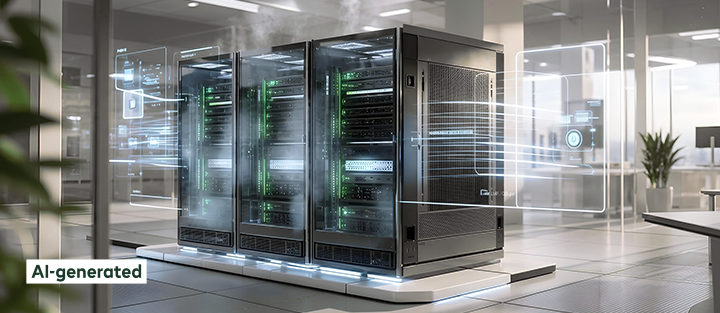
A modern server room with a cooling system

How can data centres become more efficient and sustainable?

Energy-efficient hardware, optimised cooling and modern server consolidation can significantly reduce both energy consumption and space requirements without compromising performance—in fact, they can even help improve it. With sustainable, scalable and intelligent solutions, we help you lower operating costs, reduce your data centre’s carbon footprint and prepare your infrastructure for future requirements and regulatory demands.

Benefits of a sustainable data centre:

Euro Icon

Lower energy costs.

Modern solutions can significantly reduce your energy costs—in many cases by 20 to 50 percent.

Performance Icon

Improved performance.

High-performance hardware reduces the number of servers required while creating capacity for additional workloads.

Icon increase

Stronger market positioning.

Sustainability initiatives enhance your company’s image and prepare it for future regulatory requirements.

Important Info

Award-winning partner.

Bechtle places strong emphasis on sustainability and was recognised by Schneider Electric with the Sustainability Impact Award in 2023.
Server consolidation – More performance, smaller footprint.
Liquid cooling – Direct cooling for greater efficiency.
Hot and cold aisle containment – Rethinking cooling.
Management software – Making optimisation potential visible.
Server consolidation – More performance, smaller footprint.
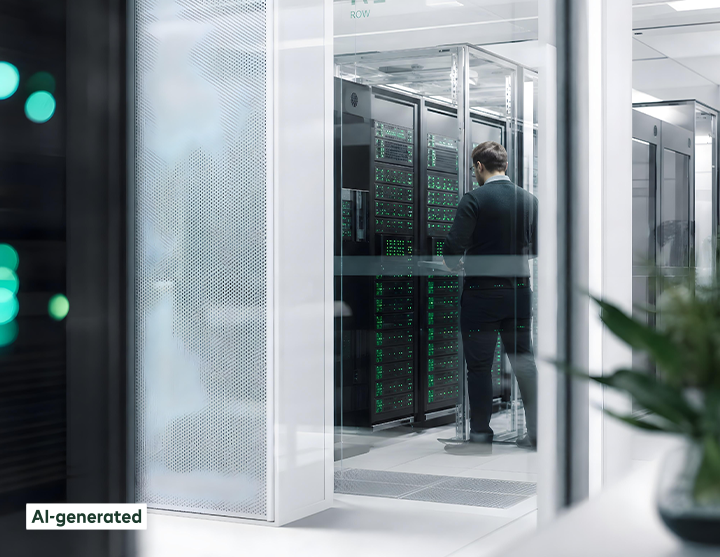
A man in a black suit is working in a server room

Many data centres are reaching their physical limits, with constrained space making it difficult to accommodate additional servers and available power capacity already stretched, bringing hardware efficiency into sharper focus.

Modern servers with high-performance multi-core processors and fast SSDs can replace multiple legacy systems, helping reduce operating costs, maintenance effort and space requirements. At the same time, moving workloads to the cloud can lower energy consumption and free up internal resources, while on-premises virtualisation allows existing hardware to be used more efficiently by allocating resources flexibly across different workloads.

Effort: 1/5       Impact: 5/5
Liquid cooling – Direct cooling for greater efficiency.
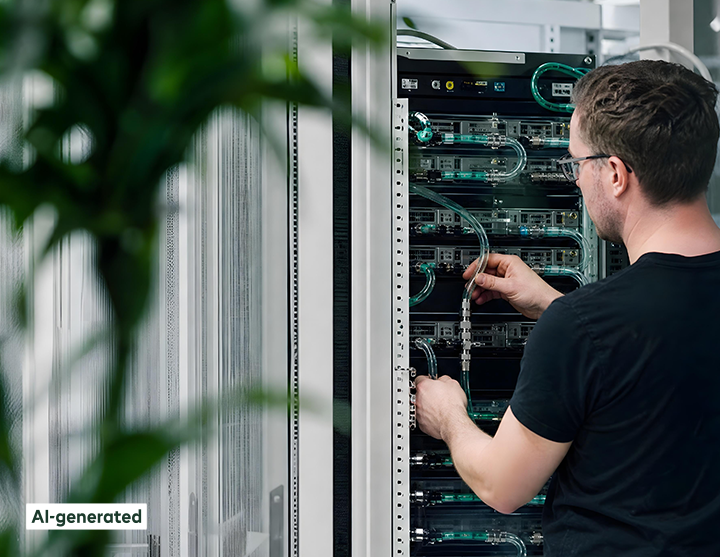
A man in a black shirt is fixing a server

As workloads continue to grow more demanding—particularly with AI applications—high-performance IT systems generate increasing amounts of heat and require efficient cooling, with cooling costs in many cases triple the cost of running the systems themselves. This makes efficient cooling technologies such as liquid cooling essential. By using a liquid medium for direct heat exchange at the component level, heat can be dissipated far more effectively than with traditional air cooling, while also enabling higher performance density per server.

Effort: 2/5       Impact: 4/5
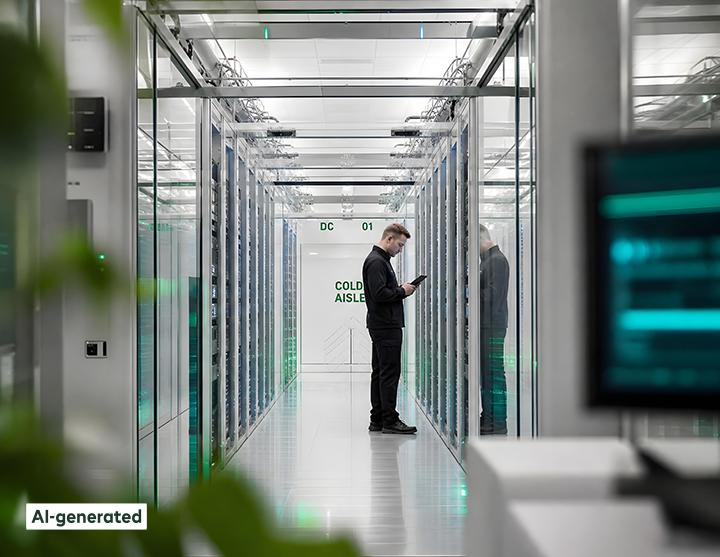
Hot and cold aisle containment – Rethinking cooling.
A man in a black suit is working in a server room

Hot and cold aisle containment is another effective approach to energy-efficient cooling, separating cold supply air and warm exhaust air to create a controlled and optimised airflow. This significantly reduces the energy required for cooling compared to traditional layouts, as it prevents the mixing of air streams and allows for higher supply air temperatures. This significantly reduces the energy required for cooling compared to traditional layouts, as it prevents the mixing of air streams and allows for higher supply air temperatures. Existing IT infrastructures can also be integrated into this type of containment.

Effort: 3/5       Impact: 3/5
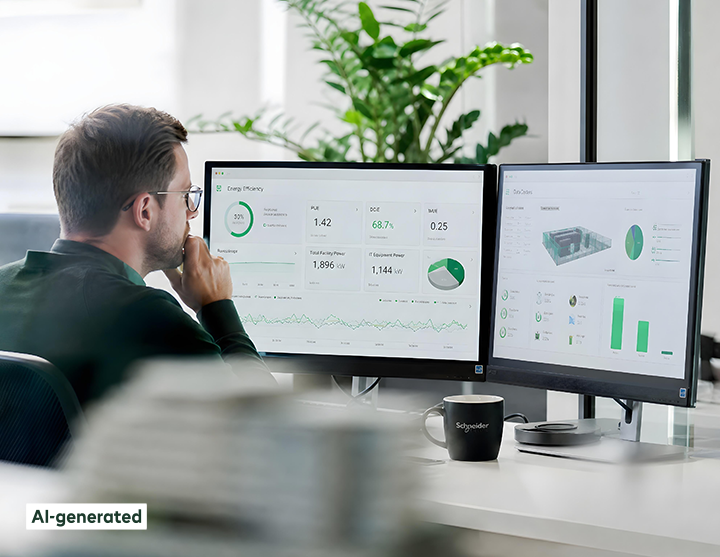
Management software – Making optimisation potential visible.
A man is working in an office with an analytical report

With a data centre infrastructure management (DCIM) solution, you can centrally monitor, manage and optimise the operation of your data centre and its components. A single dashboard provides detailed insights and key metrics on energy consumption, helping you identify and act on efficiency opportunities—for example within your cooling systems. This enables you to reduce energy costs while lowering your environmental impact. Established DCIM platforms include EcoStruxure IT by Schneider Electric and Vertiv Environet Alert by Vertiv, both of which are part of Bechtle’s partner ecosystem.

Effort: 2/5       Impact: 4/5
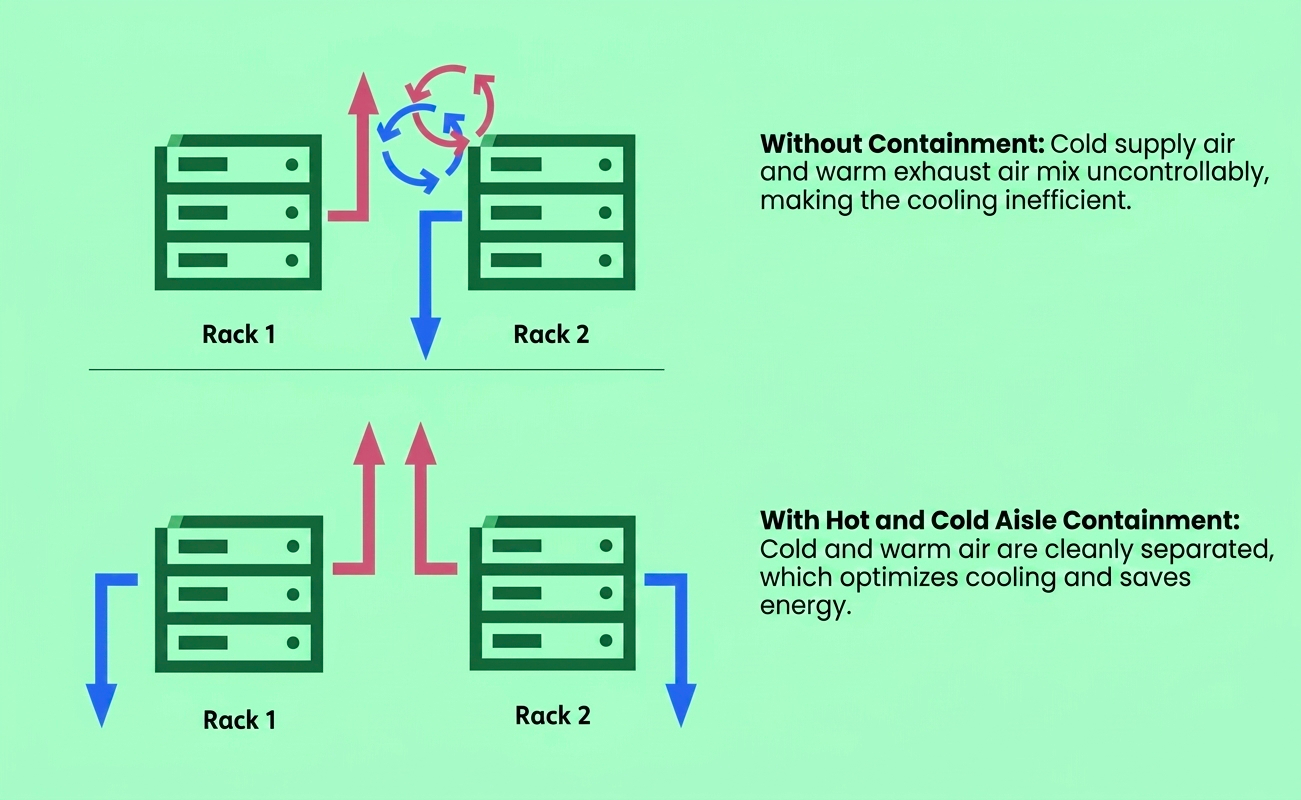
(Please click on the image to enlarge it.)

Green IT datacenter – Building a more sustainable data centre with Bechtle.

Sustainability in the data centre is not only a challenge but also an opportunity to combine cost efficiency with environmental responsibility Bechtle helps you unlock this potential with innovative technologies, deep expertise and a strong partner network. Together, we reduce your carbon footprint and strengthen your competitive position with solutions that bring together innovation and sustainability. Choose Bechtle to meet the challenges of a digital future in a way that is both sustainable and efficient.

Would you like to find out how to make your data centre more sustainable?

Whether you’d like to discuss ideas, talk through a concrete project or have any other questions, we’re happy to help. Just send us a message and we’ll be in touch shortly. 

Frequently asked questions about sustainability in data centers.

Why are sustainable data centres so important today?
How can data centre energy consumption and carbon emissions be reduced?
What is server consolidation and what are its benefits?
What advantages does liquid cooling offer compared to traditional air cooling?
What role does DCIM software play in creating a sustainable data centre?
Why are sustainable data centres so important today?

The growing use of AI, high-performance computing and data-intensive applications is driving up energy demand in data centres, increasing both electricity costs and dependence on often limited local power infrastructure. Sustainable data centres address these challenges by using energy more efficiently, lowering operating costs and reducing environmental impact, helping organisations secure economic benefits while preparing for future growth and regulatory requirements.

How can data centre energy consumption and carbon emissions be reduced?

The greatest impact comes from combining energy-efficient hardware, intelligent cooling and modern server consolidation, as high-performance systems can replace multiple legacy servers and reduce power consumption, space requirements and maintenance effort. In addition, optimised cooling approaches such as hot and cold aisle containment or liquid cooling further reduce energy usage, lowering both carbon emissions and ongoing operating costs without compromising performance.

What is server consolidation and what are its benefits?

Server consolidation involves running multiple workloads on modern, high-performance systems that can replace several older servers thanks to multi-core processors and fast SSDs. This reduces space requirements, energy consumption and maintenance costs, while also increasing flexibility by allowing workloads to be virtualised or, where appropriate, moved to the cloud helping organisations use available resources more efficiently.

What advantages does liquid cooling offer compared to traditional air cooling?

Liquid cooling uses a fluid medium to cool server components directly, enabling heat to be dissipated far more efficiently than with air due to its higher thermal capacity. This is particularly relevant for compute-intensive AI workloads, where cooling can account for a significant share of overall energy consumption, while also allowing higher performance density per server and contributing to more efficient and sustainable operation.

What role does DCIM software play in creating a sustainable data centre?

Data centre infrastructure management (DCIM) software provides visibility into operations and energy usage by delivering detailed insights into power consumption, utilisation and cooling performance through central dashboards. This makes it easier to identify and act on optimisation opportunities—such as inefficient cooling systems or unused capacity—helping organisations reduce energy costs, lower their environmental impact and continuously improve sustainability.