Cybersecurity

An overview of the most common security threats.

These days, hybrid working is commonplace in most businesses, but criminals are seizing the opportunity to take advantage of the new normal. It is estimated that by 2025, cyber criminality will cost the world $10.5 trillion annually—confirmation if it were needed that cybersecurity is and will remain top of the agenda. What is your cybersecurity strategy?

Hybrid working has become increasingly prevalent over the last few years as people have come to realise that it’s a perfectly feasible way to work. Location-agnostic and flexible working does, however, have its flaws that cybercriminals are only too happy to exploit. Did you know that 85% of security breaches are a direct result of human error? And that 94% of malware is distributed via e-mail? 

With these figures in mind it’s more important than ever to ensure you have a robust 360° strategy in place to guarantee that all users are protected no matter where they are. It’s also critical that employees are aware of the most common threats and we’ve put together a list of them to help them on their way.

Phishing.

Phishing attacks have multiplied both in personal and professional contexts. Employees are an easy target, opening apps and e-mails that at first glance seem completely legitimate. This is why staff need to undergo regular awareness training to get them up to speed on how to recognise phishing e-mails.  

According to a recent report published by PhishLabs,, the number of global phishing websites increased 22% in 2021 compared to the previous year.

One of Bechtle’s closest cybersecurity partners, Barracuda, has carried out the most comprehensive global analysis of security in the age of remote working, showing:

  • 51% of those surveyed said they had recognised an increase in phishing attacks
  • 51% admitted they felt their employees were not in a position to deal with the cybersecurity aspects of remote working
  • 46% are of the opinion that their web applications are not secure
  • 50% allow their staff to use their personal e-mail addresses and devices for business purposes
  • 40% have reduced their cybersecurity budget as a result of COVID-19-related savings.

Ransomware.

Microsoft 365 admins are increasingly confronted by ransomware attacks. Another study predicts that 75% of businesses will have been affected by ransomware by the year 2025. When a company is affected by ransomware, its data is encrypted until a ransom is paid (which, by the way, is not recommended). When a company is unable to access its data, this can have a considerable impact on business processes and continuity,

but thankfully, awareness of ransomware has improved off the back of some infamous cases that have made it into international media, such as that of the University of Maastricht that paid a ransom to hackers after its systems had been encrypted.

Shadow IT.

With people tending to work more often from home than in previous years, shadow IT has grown exponentially. Over 80% of employees admit to sometimes using software that hasn't been officially sanctioned by their IT department, which means the probability that corporate data is being stored on personal USB sticks, laptops and shared via WhatsApp is quite high. A risky business as any data protection breaches can have far-reaching consequences for a company.

Another factor to consider is that people these days work more often in the cloud and corporate data can be easily shared with the wrong people. It is, therefore, of fundamental importance that you know where your data are at any given time. In other words, the risk of data being lost or stolen goes up when employees are working from home, you are less likely to have an overview of the apps your staff are using and compliance plays second fiddle as a result of unregulated (cloud) apps.

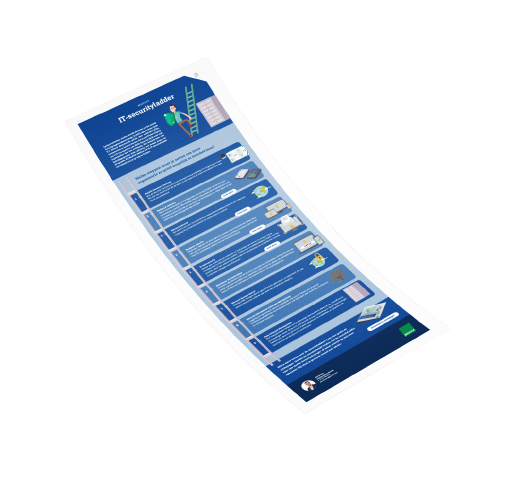
Mockup securityladder infographic


INFOGRAPHIC

Bechtle’s IT Security Ladder.

Here at Bechtle, we’ve developed an IT Security Ladder to maximise protection. Simply follow the steps to make sure your business is well-protected.

Download infographic (NL)