
On-prem is terug: waarom een hybride IT-omgeving de nieuwe standaard wordt
For a long time it looked as if organisations were moving everything to the cloud, yet we are now seeing a clear shift back to on‑prem. How do you explain that?
Clemens: “A few years ago, the cloud was seen as the promised land. You no longer had to buy hardware, run a data centre or take care of much of the technical management. That was a huge leap forward, especially for SaaS applications.
However, many organisations also moved traditional workloads to the cloud, for example by running virtual machines (VMs) in a public cloud. At that point, you realise that you still have to manage everything yourself, which makes the setup both complex and expensive. This realisation is prompting companies to take a fresh look at their infrastructure, and for certain workloads an on‑prem environment ultimately proves more efficient.
What makes modern on‑prem architecture relevant for organisations today?
Clemens: “Cost is definitely a factor. Many organisations have experienced price increases from cloud providers and are becoming more aware of the fact that data traffic comes with a cost, which is only gaining relevance as AI tools become more widely used.
AI applications work with tokens, and every prompt and every output requires computing power. When an organisation uses AI intensively, these costs can escalate quickly. At the same time, the demand for data control is rising. Organisations want clarity about where their data is stored and who has access to it.”
How do geopolitical developments influence the choices Dutch organisations make around cloud and on‑prem?
Clemens: “Geopolitics plays a far greater role than many people realise. Organisations are increasingly asking what would happen if their access to a cloud platform were suddenly cut off, and in certain situations legislation can even require that access be restricted. These scenarios encourage a careful reassessment of their options and lead organisations to reflect on how dependent they want to be on specific cloud platforms.”
What impact do regulation and compliance requirements have? For example, NIS2 or the Dutch Cybersecurity Act (Cbw)?
Clemens: “Regulations such as the Cybersecurity Act (Cbw), the Dutch implementation of the European NIS2 Directive, and the Digital Operational Resilience Act (DORA) sets stricter requirements for security and data governance. Executives can even be held personally liable if they fail to take adequate measures, which is why organisations need to demonstrate ever more clearly how their IT infrastructure is set up and how they manage their risks.”
What challenges do organisations face when they want to modernise their infrastructure?
Clemens: “Many of the customers I speak with have spent years relying heavily on a single technology or vendor and now need to make fresh decisions. Almost every organisation operates a hybrid model today, with some applications remaining in the cloud while other workloads return to an on‑prem environment. The core challenge is managing multiple environments without ending up with isolated silos.
What you really want is a central orchestration layer—the automated management, coordination and organisation of complex computing systems—that works across all environments. From that layer you define access, apply policies and determine where workloads run. This approach allows you to manage your entire IT landscape in a consistent way.”

Some applications remain in the cloud while other workloads return to an on‑prem environment. The core challenge is managing multiple environments without ending up with isolated silos.
Clemens Esser, Chief Technologist at HPE
Why has a hybrid IT architecture become the new reality?
Clemens: “For most organisations it is no longer a matter of choosing between cloud or on‑prem, because the outcome is almost always a combination. SaaS applications typically run in the cloud, while critical systems remain closer to home. As a result, a hybrid model emerges naturally.”
Which workloads do you often see organisations deliberately keeping on‑prem, and why?
Clemens: “Gartner makes an interesting distinction between ‘systems of engagement’ and ‘systems of record’. Systems of engagement include web portals or applications that need to scale significantly, which makes them a good fit for the cloud. Systems of record contain an organisation’s core data—its crown jewels—and many organisations choose to keep those closer to home.”
What do you consider the key principles of a stable and future‑proof on‑prem architecture?
Clemens: “The most important step is to stop thinking in isolated silos. Many organisations still manage their environments separately, even though a single hybrid operating model is far more effective. This approach relies on a central orchestration layer that allows you to manage policies, access rights and deployments across your entire landscape.
From that layer you roll out workloads to different platforms—public cloud, traditional virtualisation or more modern environments for containers and AI. Flexibility also plays a crucial role. By taking a hybrid and multi‑vendor approach, you avoid dependence on a single supplier and keep the freedom to adapt your infrastructure as technology or circumstances evolve.”
What advice would you give IT managers who are struggling with how to modernise their IT infrastructure?
Clemens: “Start with a workload strategy rather than a cloud strategy. Begin by identifying the applications you have and the data associated with them. Once you have that clarity, you can determine for each workload where it fits best. Some systems truly are the crown jewels of your organisation, and you often want to retain a greater degree of control over them. Other applications are well suited to SaaS or public cloud because you gain flexibility and scalability in return.
When you evaluate aspects such as data sensitivity, stability and the pace of innovation, a logical hybrid model emerges. That perspective helps you make informed decisions instead of moving everything to the cloud by default.”
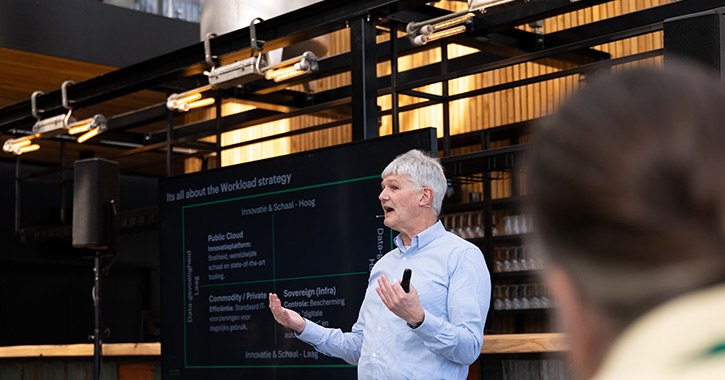
Start with a workload strategy rather than a cloud strategy. Begin by identifying the applications you have and the data associated with them.
Clemens Esser, Chief Technologist at HPE
Working together towards a modern, hybrid IT environment.
A hybrid IT environment requires a considered approach—from workload analysis to architectural choices and implementation. Bechtle and HPE combine shared expertise and technology to help your organisation design and manage a modern, hybrid IT landscape. We support you from strategic guidance through to implementation and optimisation.
Would you like to know how your organisation can find the right balance between cloud and on‑prem? Get in touch with our experts and discover how a hybrid infrastructure can give your organisation greater control, flexibility and long‑term resilience.