Smart analytics platform instead of MDM
by Nils Linnemann
Companies usually manage their devices using MDM solutions. New tools such as HP WXP, on the other hand, continuously analyze the entire IT environment.
Written by

A mobile device management (MDM) solution is now standard in many IT departments. No wonder, because it automates a large part of the device management. MDM tools distribute software, enforce policies, and integrate endpoints into an organization's IT environment. But these systems have their limitations: they only manage the digital touchpoints, but they can't analyze them. If an employee's notebook slows down or a driver causes problems, troubleshooting begins. The procedure is usually the same: create a ticket, record the problem, find the cause laboriously. Smaller IT departments in particular often only react to disruptions, which costs time and resources. The solution: Identify problems before failures occur.
Analysis – but intelligent please.
This is exactly where new analytics platforms such as the "Workforce Experience Platform" (WXP) offered by HP come in. The cloud-based platform extends classic device management with continuous analysis of all assets within an IT environment. As a result, many faults in the system and on end devices are detected at an early stage. This is made possible by the "HP Insights Agent" software agent, which is installed on every end device.
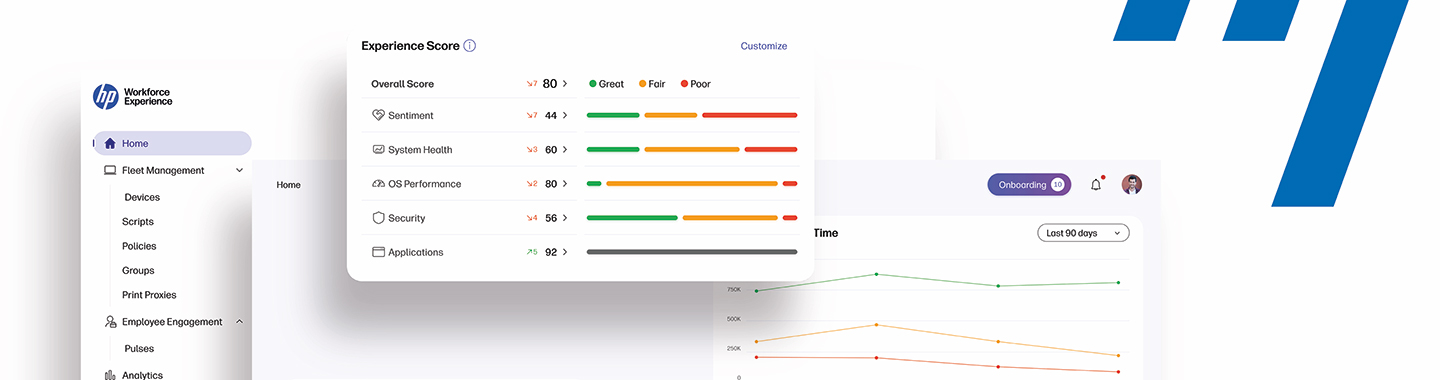
The platform is not limited to hardware from HP. Systems from a wide range of manufacturers can be integrated – whether PC, switch or printer and regardless of whether Windows, macOS, Android or iOS. The agent collects technical information about the status of these assets in the background, such as utilization, installed programs, driver statuses, or error messages. The data is automatically transferred to the platform located in the cloud and evaluated there. In this way, pure device management with WXP becomes a comprehensive asset management platform that makes the status of the entire IT infrastructure visible. For IT, this creates a new image of its own infrastructure. In the clear, automated dashboard, administrators can immediately see when devices are unusually busy or a software update is causing problems on several computers.
The platform can also generate reports automatically or provide recommendations for action. Built-in AI helps administrators resolve issues and enables rule-based automations. If, for example, defined limit values are exceeded, the platform can automatically trigger measures, such as installing updates or notifying administrators. This creates a new IT service with automatically identified end-of-life devices, proactively replaced hardware, and a strategic plan created by the platform.
New hardware maintenance and lifecycle capabilities.
In addition to the analysis, HP has recently added some other helpful functions to its platform. For example, it is now possible to carry out remote maintenance at the hardware level via WXP. In combination with Intel vPro-enabled devices, the IT department can even perform maintenance work at the out-of-band management (OOBM) level and thus even reach devices whose operating system no longer boots correctly, is completely switched off or if the main network is down. This saves time and costs – at least for hardware with an Intel CPU. This is because these devices no longer have to be checked or sent in on site, but can also be completely diagnosed remotely – worldwide.
The platform also supports the lifecycle management of the devices. On the basis of the stored serial numbers, it keeps track of when devices have been purchased or support contracts expire. WXP automatically links serial numbers to warranty and support information. This gives administrators early indications when devices are approaching the end of their support cycle and allows them to plan their replacement instead of reacting only to failures.

Particularly interesting for smaller IT teams.
The analytics and monitoring capabilities of a platform like HP WXP aren't just for large corporations with their own device management teams. WXP is ready for use from ten devices and is therefore also suitable for small and medium-sized companies, in which often only one or two IT managers have to look after everything.
The analytics platform gives administrators a quick overview of the health of all devices in the company, whether they are notebooks, printers or other systems. This makes it possible to identify unusual error messages or unusual system load at a glance. Devices from different manufacturers can also be brought together in one platform. This, in turn, makes it easier to keep track of heterogeneous IT environments, which are particularly common in medium-sized companies.
When IT suddenly gains time.
However, the greatest effect is evident in daily operation. Instead of constantly responding to support tickets, an analytics platform like HP WXP allows IT to identify many issues before they lead to an outage. For example, if several devices of a certain year of construction increasingly develop performance problems, IT can react and gradually replace the systems before they become a support case. Or it detects at an early stage if a newly introduced software requires an unusually large amount of resources on some devices. After the AI-based root cause analysis, adjustments can be made quickly. The result: proactive management of the infrastructure instead of reactive bug fixes and more time for the further development of one's own IT.
Easy to implement.
Despite the extensive analysis functions, getting started with a platform like WXP is comparatively straightforward. After registering the devices on the network, the agent is installed on the end systems and automatically starts collecting data. Integration into existing IT environments is also possible: interfaces to solutions such as Microsoft Intune, Entra ID or ServiceNow allow existing management systems to continue to be used and at the same time receive additional analyses. Often, a short workshop with a partner like Bechtle is enough to get the platform up and running and receive initial evaluations. An analysis of the existing infrastructure is also carried out at the same time. HP WXP is therefore quickly ready for use, the technical hurdle is manageable.
… and safe.
The HP WXP cloud-based analytics platform is not only quick to deploy, it's also secure. Completely GDPR-compliant, it uses integrated security mechanisms. The telemetry data collected via the agent is transmitted to the platform in encrypted form and processed there. At the same time, WXP continuously checks whether devices comply with the defined company policies. If, for example, security-relevant updates are missing or systems no longer correspond to the defined configurations, IT is automatically informed. In addition, the platform complies with international security standards such as ISO 27001, ISO 27701 or SOC 2 Type 2. For companies, this means that the infrastructure remains clearly and efficiently managed – and can also be operated securely in the long term.
This closes the circle to classic device management. MDM remains a foundation for endpoint management. However, platforms like WXP add a new layer of transparency and intelligence to them. IT departments can thus detect developments in their infrastructure earlier and operate their systems in a more targeted manner and efficiently.
The author.
Nils Linnemann is Sales Consultant – Modern Workplace at Bechtle direct AG, Switzerland. He supports companies in the implementation of modern workplace concepts – with a focus on cloud-based solutions, device diversity and secure, flexible collaboration.

Partner.

Contact.
Do you have questions or would you like a personalized consultation?
Contact us now for a non-binding discussion.
This article was created in collaboration with Swiss IT Magazine.