


Download the white paper for free now.
Learn how municipal utilities can make better use of existing data and make more informed decisions.
Municipal utilities and energy providers face significant challenges as the energy transition, grid expansion and rising regulatory requirements increase pressure on decision‑making, while staffing levels remain limited.
At the same time, more data is available than ever before, yet in practice this information is often scattered across disparate systems such as GIS, ERP platforms, network documentation and Excel files. Decision‑making therefore becomes time‑consuming and inconsistent, or continues to rely on individual experience rather than on a coherent and shared data basis.
The whitepaper explains how utilities can overcome this fragmentation by bringing together operational, geospatial and enterprise data to establish a common foundation for decision‑making, strengthening efficiency and planning reliability in the process.
Drawing on practical examples from municipal utilities, the paper also shows how an integrated data platform can be implemented without replacing existing systems.
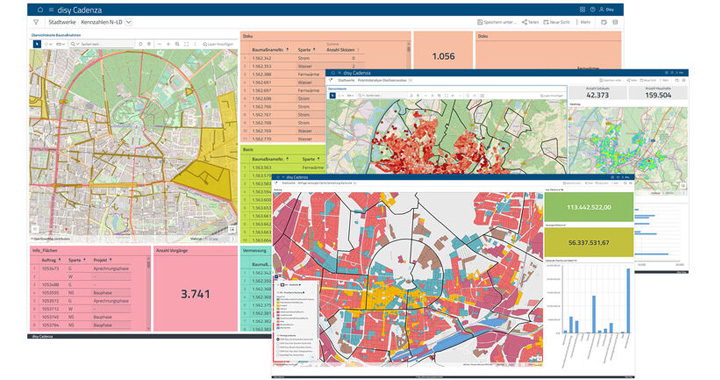
Information from GIS, ERP and specialist systems is consolidated into a unified view.
Clear and reliable foundations for planning, network expansion and reporting.
Reduced coordination effort, fewer manual analyses and more streamlined processes.
A real‑world case study from a utility operating an integrated data platform.
The energy transition, grid expansion and rising regulatory requirements mean that an ever‑growing number of decisions must be based on a wide range of different data sources. At the same time, relevant information is often dispersed across multiple specialist systems, making it difficult to gain a coherent overall picture.
Without a shared data foundation, coordination effort increases, decision‑making slows down and outcomes become harder to trace, turning an integrated view of data into a decisive prerequisite for municipal utilities and energy providers.
By bringing together business, geospatial and specialist data, utilities create a shared basis for decision‑making across departments, management and project teams, while existing systems remain in place and are connected via a central analytics platform.
Dashboards, maps and reports then make relationships easier to identify and support well‑founded decisions based on a consistent data view.
The network services division of a large municipal utility has evolved its data landscape to consolidate information from multiple systems and make it usable for planning, analysis and reporting.
The whitepaper describes this approach in detail and outlines the experience gained in practice.
Learn how municipal utilities can make better use of existing data and make more informed decisions.
The DISY Data Platform Utilities are supplementary modules designed for the professional operation of the disy Cadenza data platform. They support key tasks such as data integration, platform operations, data governance, and security management. The goal is to operate complex data platforms in a stable, scalable, and traceable manner. Organizations with high requirements for transparency, data protection, and digital sovereignty benefit particularly from the utilities, as they enable the structured use of analytics, reporting, and location intelligence applications.
Data Platform Utilities simplify the integration of heterogeneous data sources into a central data platform. They enable the connection of business applications, databases, and external data through standardized processes. This improves data quality, consistency, and timeliness. Automated import and transformation mechanisms reduce manual effort and create a robust single source of truth. This is an important prerequisite for reliable data analyses, reports, and spatial evaluations in disy Cadenza.
A key focus of the DISY Data Platform Utilities is on data governance, data security, and compliance. The utilities support role-based access models, clear lines of responsibility, and transparent data processes. In this way, they help organizations comply with legal requirements such as data protection and documentation obligations. Especially in public administration or regulated industries, the utilities build trust in data-driven decisions and strengthen digital sovereignty over sensitive data and applications.
The Data Platform Utilities are particularly well-suited for public administrations, large organizations, and federal structures with complex data landscapes. Typical use cases include environmental and infrastructure planning, administrative management, financial control, and disaster management. Wherever multiple data sources, diverse user groups, and high demands for scalability and security converge, the Utilities offer clear added value. They support both individual departments as well as organization-wide or cross-agency data platforms.
During operation, the DISY Data Platform Utilities ensure the stability, efficiency, and scalability of the data platform. They support monitoring, automation, and structured management of data and applications. This helps minimize operational risks and enables the faster implementation of new analytics use cases. Organizations benefit from lower operating costs, greater transparency, and a future-proof data analytics platform that flexibly adapts to growing requirements.