
Immersive technologies are revolutionising education.
Discover design ideas and a host of use cases in our whitepaper.
(Only available in German)
The benefits of extended reality in classrooms.
From industry, science and medicine to art and culture, immersive technologies have already had a lasting impact on numerous sectors and areas of life. Extended reality (XR) allows users to create virtual or augmented worlds that support new ways of interacting and unique experiences—including education. It has the potential to completely reimagine classic teaching methods and deliver educational content in a way that is innovative, inclusive and hands on, which has been proven to significantly improve both learning outcomes and students’ ability to retain information.
XR use cases – From molecules to Mars.
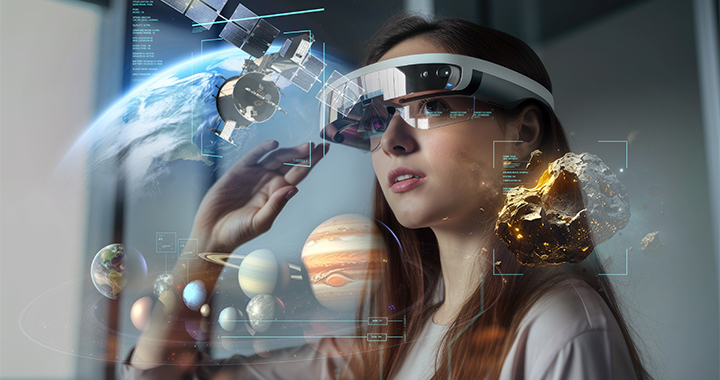
The potential of XR in education is vast, making it suitable for all types of schools. Virtual internships, for instance, offer students their first glimpse into, for example, day-to-day life in healthcare and support early career orientation. When it comes to the sciences, XR enables students to interactively explore biological processes or observe the solar system up close, and chemical and physical experiments that would be too expensive or dangerous in real life can be safely conducted in virtual environments. Whether it’s ordering a croissant in a French café, exploring Anne Frank’s hiding place, or making music in a virtual space, immersive learning environments bring knowledge to life and foster creativity.
Extended reality includes multiple immersive technologies.
Enhances the real world with digital content visible through AR glasses or smartphones. AR is already being used in industry, retail, museums, and navigation solutions.

Creates a fully simulated digital environment that can be experienced wearing a VR headset. This technology is used in architecture, healthcare, engineering and gaming.

Combines VR and AR by embedding virtual objects into the real world, allowing users to interact with them in real time. MR is used in a variety of fields, including training, product design, and logistics.
Teaching with XR – Engaging, visual, and inclusive.
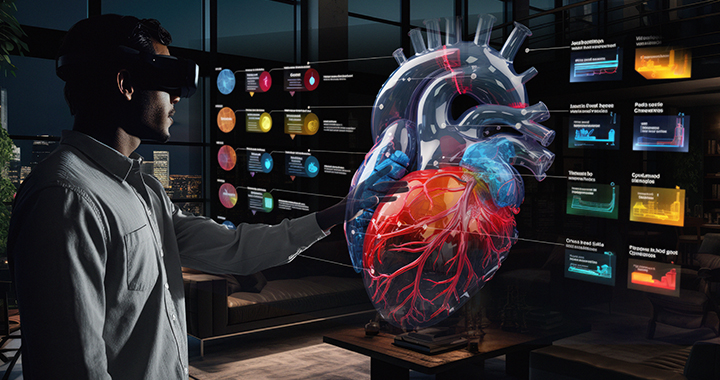
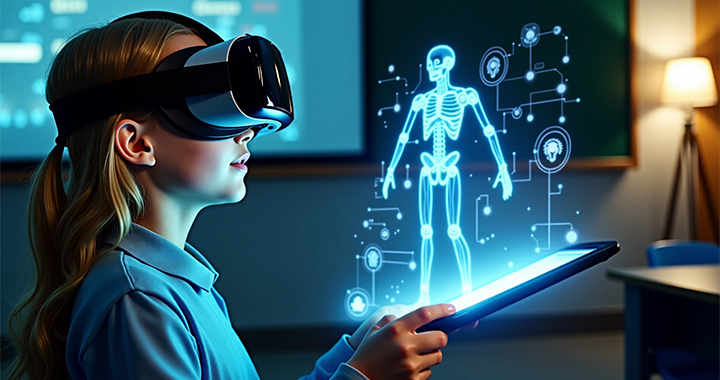
XR applications enhance intrinsic motivation by immersing learners in realistic scenarios and making learning both enjoyable and meaningful. Three-dimensional representations—such as a lifelike beating heart—can be explored from every angle, helping to visualise complex concepts and make them easier to grasp and allowing learners to progress at their own pace. XR can also be tailored to accommodate physical and sensory needs—for example, through sign language integration or tactile feedback. This opens up new possibilities for inclusion, from overcoming language barriers to enabling the free exploration of different countries and cultures.
Want to learn more about extended reality in education?
Download our whitepaper.
(Only available in German)
Getting started with XR.
Bechtle offers tailored XR learning environments.
For an immersive experience, all components—tablets, AR and VR headsets, and the corresponding applications—must be perfectly coordinated with each other and Bechtle ensures seamless integration between equipment and comprehensive service. Educational institutions can choose from a wide portfolio of offerings from various manufacturers and certified partners, all of whom meet the highest security standards. Our services include in-depth consultation, including application examples, and—depending on your needs—implementation, customised training, device management, managed services, and ongoing support.
Bechtle offers tailored XR learning environments.
For an immersive experience, all components—tablets, AR and VR headsets, and the corresponding applications—must be perfectly coordinated with each other and Bechtle ensures seamless integration between equipment and comprehensive service. Educational institutions can choose from a wide portfolio of offerings from various manufacturers and certified partners, all of whom meet the highest security standards. Our services include in-depth consultation, including application examples, and—depending on your needs—implementation, customised training, device management, managed services, and ongoing support.
XR in education with Bechtle.
Extended reality is taking learning to a whole new level, enabling personalised learning experiences, evoking emotions, and deepening understanding. The key is to ensure it is integrated into teaching with careful planning and in line with sound educational principles.
Tobias Furmaniak, Education Lead Germany
Extended reality – A win for teachers and students.
Extended reality applications are a valuable addition to any classroom and do not replace proven teaching methods or the personal interaction between teachers and pupils. Immersive technologies enrich learning by offering practical, inclusive experiences that help prepare learners for life and the world of work.
(This asset is only available in German)
* Mandatory field.
If you’d like to know more about how we handle your personal data, please read our Privacy Policy.