“We already have everything we need for technological success—education, research, industry and capital.”
Dr Tina Klüwer is an AI researcher, startup founder and author. Her book “Zukunft made in Germany. Why we must invest in innovation now to protect our prosperity” explores how we engage with technology and how we can spark enthusiasm for the future. In this interview, she talks about artificial intelligence, how to drive innovation, Europe’s strengths and identity, and the mindset needed to stay competitive on a global stage.
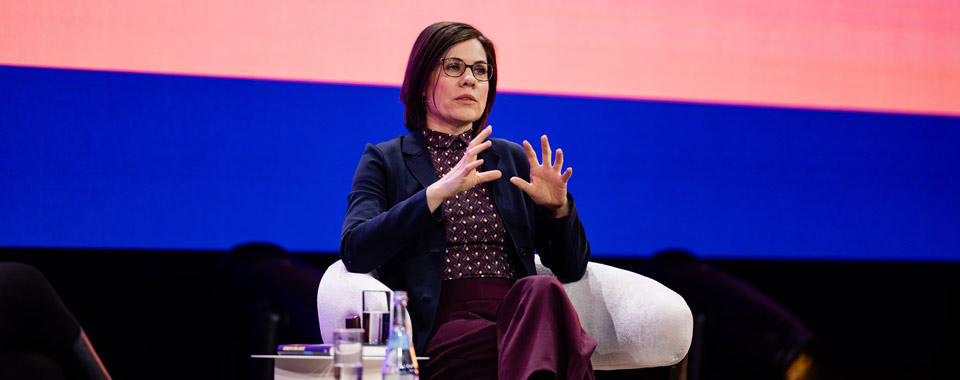
Dr Klüwer, let’s dive straight in: Artificial intelligence—hype or a reality that’s already defining today and tomorrow?
Tina Klüwer: Both (laughs). Thanks to generative models, AI has reached a level of maturity and quality that makes an enormous economic difference. Right now, most companies aren’t yet tapping into this potential because many of their efforts are still primarily focused on efficiency. The next step has to be about creating new products, offerings and services. That’s where the real disruption lies, because efficiency gains will inevitably level out over time.
When we talk about disruption, “Open Claw” is a key example. It’s a platform where AI agents interact exclusively with one another.
In my view, OpenClaw is groundbreaking—a clear sign of where things are heading. The era of passive chatbots is coming to an end, and we’ll see agents that genuinely think ahead, don’t have to be prompted by us and can carry out tasks independently.
Let’s get back to the here and now for a moment. Has Germany missed the AI boat?
For now, yes but that won’t remain the case. Let’s take the automotive industry, for example. Early innovations came out of the UK, but our predecessors caught up, refined those ideas and built an industry that shaped this country for decades—and still does. I see a similar trajectory for AI.
But to make that happen, we will absolutely need Germany’s SMEs. Is AI generally underestimated in that segment?
I’m afraid so, even though a lot has changed in recent years. Bitkom, the digital industry association, regularly surveys how companies are using AI, and those results clearly show that the rise of generative AI is triggering a shift in thinking. But the shift remains slow, overly cautious, in my view, and lacking structure. I tend to come across two types of companies. On the one hand, those that encourage their employees to try out AI, gain experience and work with agents, and on the other, companies that, out of concern for data, data protection, processes or similar issues, impose broad restrictions. The second approach simply doesn’t work, but the first one is only partly effective, because it can create unstructured experimentation that later needs to be brought under strategic control. Since many of these companies can’t afford a large, dedicated AI team, having the right partner will be absolutely essential, and finding that partner is a Herculean task in the current AI landscape.
These companies have the opportunity to develop specialised AI not only in Germany, but across Europe. Is that the direction we’re heading in?
Yes and no. If I look at Germany as an industrial nation, there is clearly a strong opportunity—thanks to our experience and the data we have—to develop smaller, specialised and powerful models. That will be valuable, but I also believe that the large generative models will remain the gold standard for the foreseeable future. And I don’t want us in Germany and Europe to focus on countless niches while losing sight of the bigger picture.
It’s about choosing the future, not trying to preserve everything from the past, but adopting a mindset that looks ahead rather than back.
Dr Tina Klüwer
In your book, you write that Germany must aspire to be among the global leaders in emerging technologies, because only then can we secure our long‑term prosperity ...
I firmly believe that, but we won’t achieve it on our own. We need a strong Europe—not only for economic reasons, but also for geopolitical ones. For several years, we’ve been observing a fierce race for future technologies between the US and China, while we remain mostly on the sidelines. In the future, we need to play an active role in shaping this, because it’s also about technological and digital sovereignty. And it’s important to stress that this does not mean becoming completely self‑sufficient and doing everything alone. We can’t cut ourselves off, but we do need to think carefully about what we can contribute to help create balance.
Does this apply only to artificial intelligence?
No, it’s about future technologies in general. The value that technology can create is enormous—across every sector. Biotechnology and quantum computing are just two examples among many. These are the forces that will create value in the future.
How do we get there?
One major factor is the connection between research and industry—an area where Germany, even without its European partners, ranks among the top three worldwide. It’s not enough to produce outstanding publications and patents if we fail to turn them into economic value because we preserve a divide that makes deeper industry–research collaboration seem unwelcome. But business and science need a shared purpose and vision.
And what about (political) courage?
Courage is a key driver on many levels—including, of course, in politics. The European Union has significantly adjusted its approach and is now thinking far more in terms of innovation and the future than it did a few years ago. We already have everything we need for technological success—education, research, industry and capital. Now we have to choose a vision for the future and focus on it collectively as a society.
Because there’s a lot at stake?
A fate we share with other traditionally strong industrial nations—Japan, for example. We need to act now, harness the opportunities of new technologies and secure our future.
How can companies best do that?
By acting with an entrepreneurial mindset and reassessing risk in a way they don’t typically do. In innovation projects, the focus is too often on the immediate costs—and too rarely on the cost of not moving ahead What is the price of failing to advance this innovation? And what happens if our competitors innovate and move past us?
Are companies also lacking confidence?
Unfortunately, yes. And perhaps what many need to hear again is that Germany’s SMEs are strong, our companies are strong, Europe is strong. We have so many hidden champions whose products are world‑class, and they need to project their strength as the innovative market leaders they are. We also need to free ourselves from a media narrative that delivers a daily obituary for Germany and Europe. What we need are CEOs and managing directors who say: “We started out as an innovative company, and we’ll remain one—even in an era of new technologies.”
So it’s also a mindset issue?
Absolutely. It’s about choosing the future, not trying to preserve everything from the past, but adopting a mindset that looks ahead rather than back. That’s important for all of us as individuals, but also for policymakers, because it shapes decisions like where we invest and how we design our education systems.
What makes you optimistic?
What I see every day when I visit companies, especially start‑ups, is people who are focused on the future, who want to shape it, who are excited about it and who consistently choose the future. Each of us can help shape that narrative—through the decisions we make every day as consumers. Do we cling to the past, or do we choose to build the future?
About.
Dr Tina Klüwer has spent years working at the point where science meets real‑world application. As a PhD‑trained AI researcher, startup founder and, most recently, as a department head at the Federal Ministry of Research, she has not only followed the development of future technologies but actively shaped them. She understands what it takes for innovation to emerge and how vital these technologies are for prosperity and security. As a sought‑after voice in politics, business and the start‑up ecosystem, she offers clear insights into where AI and innovation really stand in Germany and around the world, and where they are headed next.