Language at scale – How DeepL is transforming global business.
From arriving in Germany as a child without speaking the language to leading a global AI company: DeepL CEO Jarek Kutylowski reflects on intuitive learning, the future of language, and why Europe needs to be bolder on AI.
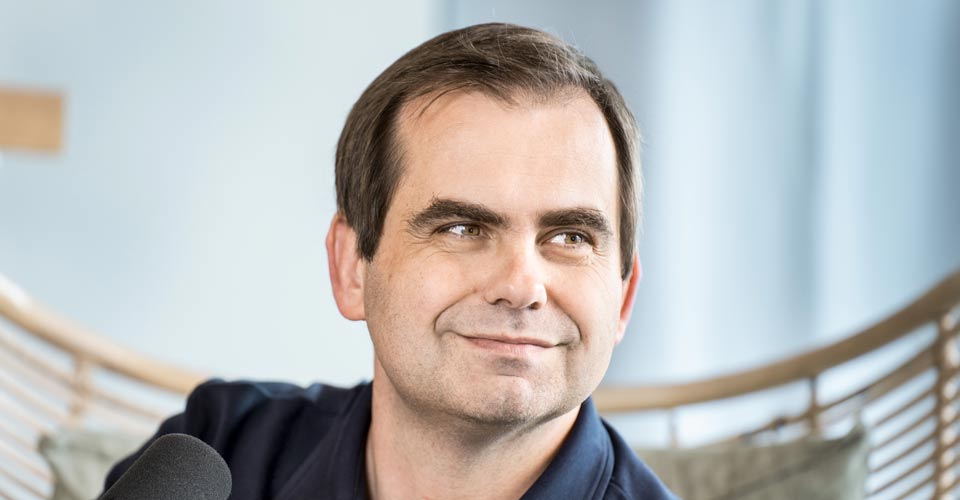
Dr Jarek Kutylowski is the founder and CEO of DeepL, a Cologne-based AI language technology company developing secure, intelligent solutions for complex business use cases. Born in Poland, he has spent most of his life in Germany, bringing an international perspective to his passion for technology. A dedicated developer, he began building practical tools for everyday use at the age of ten. He later pursued a doctorate in computer science, specialising in mathematics, and worked at several technology companies before founding DeepL.
Jarek, you moved from Poland to Germany as a child – how did that experience shape your relationship with language?
Jarek Kutylowski: I remember my first day at school very clearly. I walked into the classroom and couldn’t understand a word – not the teacher, not the other kids. I was thrown in at the deep end and had to just find my way. The first day was tough, the second wasn’t much better – but then things started to fall into place. Your brain just adapts, you pick things up, you learn intuitively. I didn’t know any formal grammar, but I could get by in German pretty quickly.
Is the way children pick up a language similar to how you teach language to an AI?
In some ways, yes – but in others, it’s very different. We don’t teach models grammar, and we don’t have them learn vocabulary in the traditional sense. Instead, they process vast amounts of text and gradually build an understanding of language, and ultimately of the world as it’s expressed through language. Humans need far less data to learn a language, though, and that’s something we still need to improve. Models have to become more efficient. We need to be able to achieve the same results with much less training data.
Why is that important?
Because building more efficient models saves resources, time and money. It also means we can achieve better translation results in languages where less data is available. For German and English, there’s an abundance of data in both directions. But with language pairs like English and Polish, there’s simply not as much to learn from. And that’s reflected in the quality of the results.
You’ve been working on translation quality since 2017. Take us back to the early days.
People often ask me how much courage it took me to start the company. Honestly? Not that much. I didn’t have anything to lose. My investment was my time, and I had plenty of that. I enjoyed it then, and I still do today. What’s changed is the responsibility. Back then, there was hardly any – now it’s huge. That shift happened fairly quickly. The tool spread at an incredible pace for the time, and we suddenly found ourselves very much in the public eye. We’d achieved what we set out to do, which was to build a platform that genuinely helps people, both in their personal lives and, above all, at work.
Can you trace DeepL’s success back to any one particular decision?
I think an important part of it was that we were determined to offer a free service, even in 2017, when it was much harder to secure the computing capacity you needed to make AI models available to a large audience. Back then, we didn’t have GPUs or the flexibility to simply move from one host to another.
What made you decide to enter the language space in the first place? Google Translate and others were already there…
We were very clear about what we wanted to do. We set out to build the best service on the market. And we genuinely enjoyed working towards it.
What would you do differently today?
We could – and should – have moved faster when it came to monetisation. In that respect, we were very European in our approach. A US company would have been much more aggressive.
Speaking of money, there are no major German names among your investors…
During our early funding rounds, the German capital market simply wasn’t as developed as it is today. And we very quickly moved into funding volumes that, even now, the German market struggles to match. In Germany and across Europe, we’re well positioned when it comes to early-stage and seed funding. But for growth financing, the US and global markets still have the edge. That was also part of our strategy: we wanted to build a global company out of Cologne, and choosing the right investors played a key role in that.
What were some other factors behind your success?
In the early days, Cologne actually helped because it wasn’t a tech hub. There simply wasn’t the same competition for talent. But we always set out to build a global company, so we moved beyond that phase fairly quickly. We started hiring across Germany and internationally to bring in the right people.
And the wider conditions matter too. You recently said Europe would be better off without the AI Act. Why?
I stand by that, even if it was taken slightly out of context. In Germany and across Europe, we tend to focus too much on the risks around AI. From where I stand, the bigger risk is that we don’t seize the opportunities and fall behind. AI will account for a significant share of global value creation, and we can’t afford to lose ground.
Can’t regulation also be a good thing?
Right now, we’re not creating the kind of environment that attracts researchers and founders. People look at where they can actually succeed, where what they build is valued and used. And at the moment, Europe isn’t sending that signal. If we’re honest, regulation tends to hit smaller and younger companies hardest, because they simply don’t have the legal resources to deal with it. And the AI Act, as it stands, risks isolating the European market. AI is inherently global. If you want to succeed in this space, you have to think and operate globally. We’re actually a good example of that ourselves, as is Spotify, for instance.
A global market means global competition. What sets DeepL apart from Google, OpenAI and the others?
Two things: our focus on language, and how we apply it for our customers. We don’t just build the technology – we work with companies to put it to use in their day-to-day operations in a way that creates real value. That’s where the real challenge lies. Take customer service. It’s not unusual for support teams to be based in a different country altogether, dealing with messages in a language they don’t actually speak. That’s where DeepL comes in. We integrate directly into those workflows so language stops being a barrier. It shouldn’t slow anything down.
How does this understanding of your customers come through in the language itself?
We understand how language is used in a company – the way specific terms are translated in their context, and what certain words imply across different languages and cultures. Ultimately, multilingual communication is about more than just translation.
Interestingly, DeepL performs particularly well for Japanese.
Japan is actually one of our largest markets. And if you look at it more closely, that’s not so surprising. Japan is deeply integrated into the global economy, and many of us use Japanese products every day. The language barrier is very high, though – Japanese is a very complex language. But DeepL Voice is now so capable that it can deliver live translation of online meetings in Japanese as well. And it works just as well in multilingual settings. Everyone speaks their own language and hears it back almost instantly. The delay is minimal, and the results are very strong.
With all the progress we’re seeing, should children even still be learning languages?
Absolutely. Technology will take over a lot in a professional context, but outside of work I still want to be able to just talk to people directly. And beyond that, learning a language is incredibly enriching – it gives you a real feel for a country, its culture and its people. It’s also important for the way our brains develop. There’s plenty of research showing how learning a foreign language improves our ability to communicate. You still learn maths at school, even though a calculator can do it better. (laughs)
Looking ahead, where do you see a European AI company like DeepL in ten years?
First and foremost, I hope we’ll see a broad landscape of AI companies across Europe by then. We don’t need a single champion – we need an ecosystem. DeepL will be part of that. And we’ll be known as a global AI company that comes out of Europe. That’s what I’m working towards.