

Multi-Cloud: Many Clouds, Many Possibilities.
The cloud has become an integral part of everyday life. However, the question arises as to how to use it – and the uses to which it can be put. Because there isn't just one cloud, but many. In the form of a multi-cloud, several of them can be deployed simultaneously. This opens up a host of possibilities. Here is an overview.
When we stream a movie, it comes from the cloud, meaning from the streaming provider's servers. This has become as commonplace as water from the tap. The actual source doesn't matter, as long as the quality is right – in this case, the movie experience and a seamless streaming experience. However, other factors that are also located in the cloud are important for the user experience: computing and storage power, databases, analytics, recommendation engines, video transcoding, and much more. Hundreds of thousands of server instances quickly add up for this – per streaming service.
Which cloud is right for your business?
The natural use of cloud computing in the private sector is also spreading to companies and other organisations. Consumers are leading the way, and businesses are following suit. This phenomenon is called consumerisation. Cloud services are increasingly being ‘consumed’ in the business environment, too, and applications can be downloaded quickly and easily. However, IT managers are quickly faced with various questions: Which offerings, regulations, and other frameworks must be observed? How can the diverse options be used in a targeted, efficient, and application-appropriate manner? What does the multi-cloud concept promise in this regard?
Define cloud.
Public cloud.
Deployment of virtual servers from a cloud provider that are assigned to various customers.
Private cloud.
Deployment of dedicated servers from a cloud provider without shared resources.
Multi-cloud.
Combined deployment of public and private clouds from multiple cloud or IT providers.
Hybrid cloud.
Integrated solution of public and private clouds, on-premises and on-the-edge operations.
What is a multi-cloud?
"Freedom of Choice" or: the right platform for every use case. This is Bechtle's multi-cloud offering. This refers to the combination of cloud platforms and services from various providers, as well as public and private clouds. These can also be combined with on-premises operations in in-house data centres and ‘on-the-edge’ components directly at the user's or IoT agent's location. In practice, this means using, for example, Microsoft products for office IT, AWS or the Google Cloud Platform for web applications and IoT applications, and IONOS or STACKIT for systems and data that are not to be run on the infrastructure of a provider outside the EU.
So, the multi-cloud offers everything – although this is not a straightforward matter. It only becomes easy once you're properly positioned. That's where we come in. Bechtle designs the right cloud architecture for you and builds all the necessary bridges – between existing and new systems and the various cloud options. The basis for this is established by the associated goals and requirements: What should be achieved? Which regulatory requirements must be considered? What measurable effects are expected? Which use cases are relevant? Who will work with it in which roles? The initial assessment clarifies numerous questions and paves the way for a successful overall process.
Experience from SMEs and corporations
Dennis Wimmer, Lead Cloud Architect and Business Manager Multi-Cloud at Bechtle, emphasises their integrated approach: “We bring together many perspectives across the entire process. That's our strength”. At Bechtle, more than 200 cloud specialists contribute their experience from projects with SMEs and large companies, as well as from completely different industries. Our business analysts, consultants, solution architects, and cloud engineers support you from planning through migration to ongoing operations.
"What we do is lifecycle management for the complex multi-cloud construct," summarises Dennis Wimmer. Customers have a constant overview of the integrated cloud solutions. A dashboard provides all key parameters, and a consolidated invoice for all services is sent monthly. This is efficient, cost-effective, and transparent. We also support you with extensive expertise in avoiding unnecessary cloud costs. Studies have shown that 25 to 35 percent of cloud costs are unnecessary. One wrong click in the cloud configuration is enough to send your workloads on a global journey through distant data centres – for which you ultimately pay. We protect our customers from this, too.
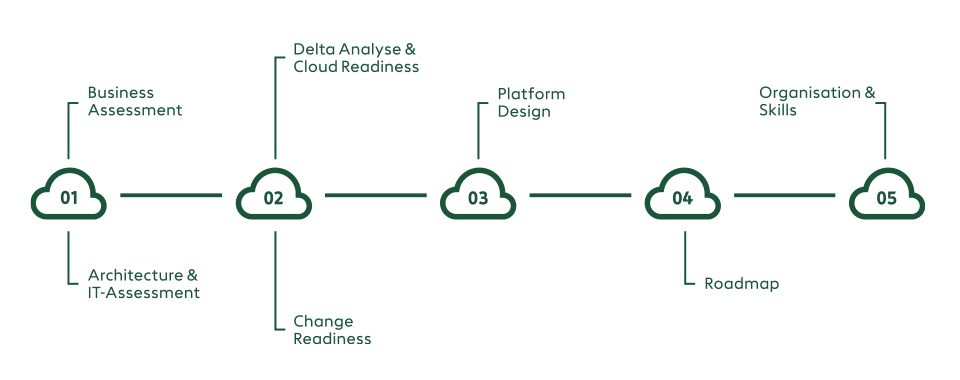
Five steps to a comprehensive cloud strategy.
Solution modules from the service catalogue.
"What may be very challenging in the background should ultimately be simple on the user side," adds Melanie Schüle, Managing Director of Bechtle Clouds. Therefore, the so-called Bechtle Service Factory is constantly working to offer even more services in a way that is as standardised, automated, and scalable as possible. Ready-made solution modules from the "service catalogue" can thus be used for a wide variety of applications. And there are more and more of them. Products are increasingly software-supported, whether cars, manufacturing or vacuum robots, CNC milling machines, or wind turbines. Flexible cloud resources are required for all of them. If AI is "built in," the need for training the models is significantly higher than for subsequent operation and service. "Multi-cloud strategies are therefore highly differentiated," says Melanie Schüle, "and ideally multi-agile." This ensures the right solution for each application and resource requirements.
Those who source everything from a single cloud are missing out on many opportunities.
Melanie Schüle, Managing Director of Bechtle Clouds
If multi-cloud is your goal, then choose Bechtle.
Bechtle is the ideal partner when it comes to implementing a multi-cloud strategy. Our portfolio includes not only US hyperscalers but also other cloud providers from Germany and Europe. But more importantly, we offer everything from a single source: from consulting, planning, migration, operations, and lifecycle management to optimisation and further development. Consolidated billing simplifies the financial aspects, as do our financing services and cost management. If needed, we also provide on-site personnel support and, if desired, relieve your team's workload with our wide range of managed services.
Visit our portfolio page for more information and a quick and easy way to contact us.