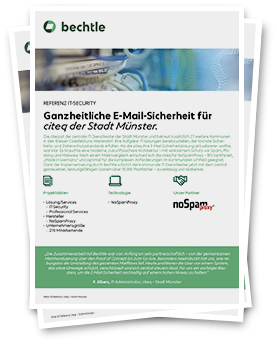


E-mail security for local authorities, critical infrastructure, and SMEs.
European solutions aligned with BSI standards.
In 2025, email will still be the most frequently used communication tool in everyday business life. However, this inevitably means that email is just as often the primary gateway for cyber attacks. Consequently, email traffic and its security are of crucial importance for any organization.
In business email, security is critical because over 90% of all cyber attacks start with email, particularly through ransomware, phishing emails or business email compromise (BEC)1.
- Almost 80% of companies were affected by email-based security incidents last year2.
- Business Email Compromise (BEC) alone caused billions of dollars in losses worldwide: e.g. more than $2.9 billion lost in the US in 2023 and over $50 billion in total between 2013 - 20223.
Emails are one of the main targets for cyber attacks and can cause financial damage, data loss and reputational damage. Modern attack methods are now extremely sophisticated and often barely recognizable as “fake”. This makes it clear that email security goes beyond purely technological approaches and requires a holistic concept.
We can only make e-mail communication in Germany more secure by working together. That’s why the E-mail Security Year 2025 campaign brings together expertise, resources, and shared responsibility. Strong support from the business community sends a clear message: digital security is a matter of public concern and collective action.
Claudia Plattner, President of the Federal Office for Information Security (BSI)
Our e-mail security solutions.
Bechtle takes a comprehensive end-to-end approach to customer security. True e-mail protection is only achieved when technical measures and organisational policies work seamlessly together.
Effective email protection: Bechtle and NoSpamProxy secure your communications with a BSI-certified solution that is “Made in Germany.”

Comprehensive email security for your organization
Find the right solution for secure email communication together with Bechtle and NoSpamProxy.
Email security at a glance.
• BSI-certified security “Made in Germany”
• Protection against spam, phishing, and malware
• Benefits of automation and cloud readiness

Email security for public institutions.
• Data protection and legal certainty for authorities and municipalities
• Secure citizen communication through encryption
• BSI-compliant email security for the public sector
Email security for SMEs.
• Flexible email security in cloud or on-premises environments
• Reduced IT workload thanks to simple integration and administration
• GDPR-compliant communication with maximum protection against cyberattacks

Implementing BSI standards.
Germany’s Federal Office for Information Security (BSI) defines a range of industry standards. We analyse these technical guidelines based on your needs and integrate them into your infrastructure. As part of the E-mail Security Year 2025, we’re actively contributing to strengthening long-term resilience.
E-mail security is about much more than just filtering out spam. Without end-to-end encryption, strong authentication, and intelligent threat detection, organisations remain vulnerable. Security must be holistic and continuously evolving.
Lars Kröllken, Head of Security, Bechtle Westfalen Niederrhein
Essential security standards defined by BSI guidelines:
Sender Policy Framework
Definition: SPF is a DNS-based mechanism that allows a domain to specify which mail servers are authorised to send e-mails on its behalf.
Function: Receiving servers check the sender’s IP address against the domain’s SPF record. If it doesn’t match, the e-mail may be rejected or flagged.
DomainKeys Identified Mail
Definition: DKIM adds a digital signature to outgoing e-mails to verify that the message hasn’t been altered and genuinely originates from the stated sender.
Function: The public key is published via DNS. Recipient servers use it to validate the signature and confirm the email’s integrity.
Domain-based Message Authentication, Reporting and Conformance
Definition: DMARC builds on SPF and DKIM, allowing domain owners to define how unauthenticated e-mails should be handled.
Function: Domains can publish policies to reject, quarantine, or deliver e-mails that fail authentication. DMARC also enables reporting on spoofed messages.
Mail Transfer Agent Strict Transport Security
Definition: MTA-STS allows mail servers to declare that incoming e-mails must be transmitted securely via TLS.
Function: Before transmission, the sender’s server checks the recipient’s MTA-STS policy. If a secure connection can’t be established, the message isn’t transmitted—protecting against downgrade attacks.
Domain Name System Security Extensions
Definition: DNSSEC extends DNS by digitally signing responses to ensure they are authentic and unaltered.
Function: Clients can verify that DNS responses come from authorised servers and haven’t been tampered with during transmission.
DNS-based Authentication of Named Entities
Definition: DANE enables the publication of X.509 certificates (e.g. for TLS) via DNS, secured by DNSSEC.
Function: E-mail servers can use DANE to declare which TLS certificate is valid, allowing verification of encrypted connections without relying on external certificate authorities.
E-mail has long since replaced letters in business and public sector correspondence. It’s a key channel for interaction and must be secure and dependable. By aligning with BSI standards, we deliver broad and robust e-mail security solutions. Our specialists support you with needs assessments, deployment, operations, and troubleshooting.
Philipp Frenzel, Senior Business Development Manager, Public Sector
Additional considerations relevant to IT Baseline Protection:
Authentication and integrity
Spam and malware protection

Logging and monitoring

Backup and archiving
Your experts.
More than 600 security specialists at Bechtle support organisations in implementing modern security strategies.
Get in touch with us now.
* Mandatory field.
If you’d like to know more about how we handle your personal data, please read our Privacy Policy.