A town hall in the metaverse – The City of Aalen breaks new ground.
Public administration needs to be where its people are. But how does that work in the metaverse? In a virtual town hall, the City of Aalen has found the answer. Mayor Frederick Brütting and Professor Markus Weinberger, Internet of Things expert at Aalen University of Applied Sciences, explain why this format is a recipe for success for the city as a whole and from an academic perspective.
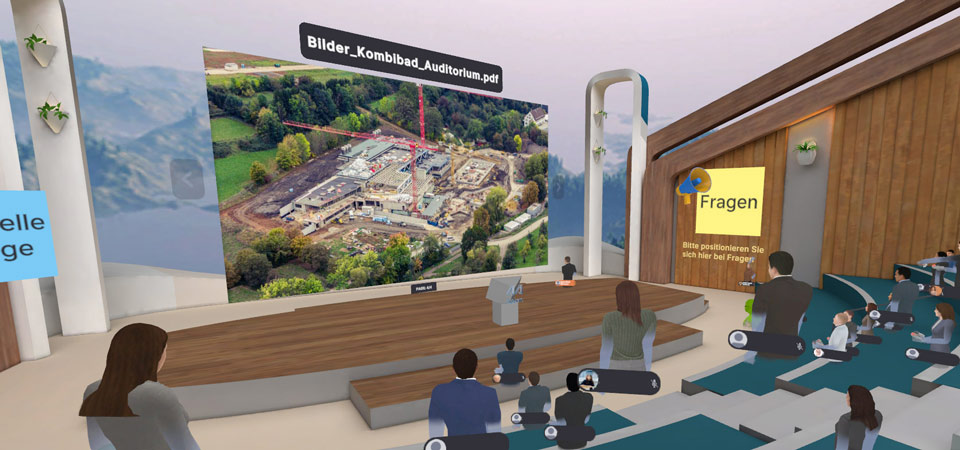
Germany’s very first digital town hall took place in Aalen at the beginning of May. Mr Mayor, did this pilot project meet your expectations?
Frederick Brütting: The expectation was that we would be able to engage with our citizens, view a digital version of our future swimming pool and generate interest in the metaverse, all of which we succeeded in doing, which I’m delighted about. We were, of course, a little bit nervous about how it would go, but you just have to hope everything runs smoothly, everyone can be heard and no-one struggles with the technology. And as a whole, that’s precisely what happened. It‘s clear that people are able to pick things up quite quickly and the whole thing was incredibly intuitive, which has made us want to continue down this path.
Do you have some ideas about how you want to make use of the metaverse in the future?
When it comes to the city’s administration, I believe there are two great opportunities. The first is communicating with our citizens. For us a city is much more than the people who live in one particular place. There are many people with links to a city, but can’t be there all the time and the metaverse is a great way to stay in touch. Then there is the ability to visualise building projects, discuss them and make modifications and therefore design good solutions in front of peoples’ eyes. A virtual walk-through of a planned building is much better than pouring over construction plans.
In my opinion, the metaverse is a great opportunity to make projects tangible so that we can then present and discuss them with the people.
Frederick Brütting
How have your colleagues responded to the project? Has it changed their opinion of virtual reality and the metaverse?
My colleagues are generally very open-minded. Those who haven’t really had anything to do with virtual reality up until now have said that the project has really opened their eyes to what is possible with the technology.
Now that you have experience, how do you respond to other mayors asking if it’s worth doing the same in their towns and cities?
In my opinion, the metaverse is a great opportunity to make projects tangible so that we can then present and discuss them with the people. Local politics isn’t about waiting for our citizens to come to us. We need to go to them wherever they are and that will increasingly be in the virtual space.
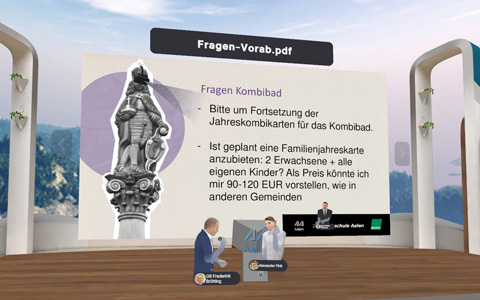
The University of Applied Sciences in Aalen is supporting the project. Professor Weinberger, can you share some insights with us?
Professor Markus Weinberger: We successfully managed to reach a heterogeneous audience. It’s a cliché that it is mainly younger people who take part in virtual town halls due to their technical prowess. We had people in their mid-twenties taking part, but also those well over 70. In fact, we had a good spread across the ages. There were also those who have experience with VR and similar technologies, and plenty that had never had any interaction with it before.
Something else we observed was that the event wasn’t centred around technical and digitalisation issues as you might expect. In fact, the agenda was entirely focused on topics of interest to the citizens and which play a huge role in city life.
Going back to the technology, when compared on a national and international level, how far down the road is the City of Aalen in its attempt to move its town halls into the metaverse?
Around the world, our urban centres are increasingly grappling with the idea of a smart city, which is a subject that’s now also widely covered by academic literature and becoming inextricably linked with the metaverse. Every conceivable application is being discussed, but there are not yet many concrete examples of them being implemented.
We haven’t been able to find any examples of a town hall meeting being held in the metaverse in the literature or on the internet. That presents the very high probability that Aalen is well-ahead of the curve if not a pioneer in its attempt to do something like this over the internet.