Astronaut Rabea Rogge: “A spacecraft flies itself. As a roboticist, I think that’s pretty cool.”
In spring 2025, Rabea Rogge spent four days in space—the first German woman to do so. Back on Earth, she’s completing her PhD in robotics and is an expert in artificial intelligence. In this interview, she shares fascinating insights into the interplay between these technologies and their impact on society. She also talks about what took her breath away in space, why she hopes much of science fiction will come true, and how we can learn to trust autonomous robots.

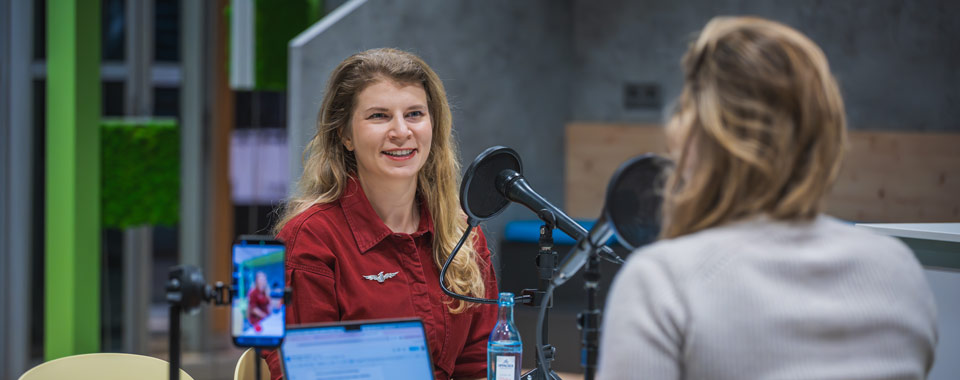
Image: (c) Mario Heller
Ms Rogge, you spent four days in space. Which moment stands out most?
Rabea Rogge: Honestly, I was a little sceptical about that big “aha” moment everyone talks about when they see Earth from above. I’ve always believed you shouldn’t need that view to appreciate our planet, and yet, it was incredible to see it like that. At first, I felt overwhelmed, but later, when we allowed ourselves the time to spend a full orbit—about 90 minutes—just gazing out the window, it was phenomenal… 45 minutes of daylight, 45 minutes of darkness. In the dark, you see lights—humanity. In daylight, humanity almost disappears, and you see oceans, polar regions, rivers and mountains. The Alps were stunning.
Did you feel a sense of awe?
Absolutely. And disbelief. We talked about how surreal it is to float in space, looking at this enormous planet suspended in a vacuum, while flying around it in a marvel of engineering. I felt an incredible sense of possibility—that humanity can achieve so much more.
When you were up there, did fear ever creep in?
I was more afraid of being afraid than of anything else. But we’d trained for a year. We knew exactly what to do if something went wrong. That gave me peace of mind. We’d rehearsed everything about 5,000 times, so we could focus completely on the tasks at hand. We were prepared for every scenario, even simultaneous medical and technical emergencies. What do you prioritise? How do you split tasks? Do we need to suit up? We had answers for all of it.
Did you actually fly the spacecraft?
My colleague Janneke and I were the mission pilots. We sat at the controls and could have intervened if necessary. But honestly, spacecraft fly themselves these days. As a roboticist, I think that’s pretty cool.
You’re doing your PhD in Norway on robotics, focusing on autonomous vehicles in Arctic environments. What exactly are you researching?
I focus on autonomous surface vehicles—robotic boats that operate on the open ocean, but we also work with underwater robots. Our goal is to understand how these systems, in all their different forms and sizes, coordinate and make decisions together.
I want us to innovate as fast as possible, but at the same time, we cannot ignore ethical questions because they carry enormous weight for us as a society.
Rabea Rogge
Why is it important?
Think of glaciers collapsing into the sea. They are extremely dangerous for humans. It’s better to keep people away and send autonomous boats. But we don’t want to lose those boats either, so I study how they weigh decisions: when to prioritise data collection and when to protect themselves. Does a robot “feel fear”?
Artificial intelligence plays a big role …
Yes, in different ways. We can define rules—for example, how to react to another vessel—but I’m more interested in extreme situations where a human captain would rely on experience and intuition. We can give the system that knowledge, but it must be able to transfer it to new environments, apply it and make strategic decisions.
So it’s about embodied AI? The fusion of robotics and artificial intelligence?
That’s right. And that’s exciting because the two fields approach problems differently. Now we’re trying to combine them, leverage their strengths, enrich datasets and incorporate strategic thinking and feedback.
Does that mean intelligent household robots are next?
I’d love one! But it’ll take time. We won’t see a sudden leap where they can do everything. Progress will come in stages, and that’s good, because we need time to build trust.
And what happens when AI makes the “wrong” decision?
That’s a crucial question. Imagine an autonomous boat colliding with a manned vessel and people getting hurt. Who’s responsible? We haven’t solved that for self-driving cars either. We need answers, and that’s on us as researchers.
Because trust depends on those answers?
Yes, and because it highlights one of the biggest challenges in research. We always try to push the limits of what’s possible. I want us to innovate as fast as possible, but at the same time, we cannot ignore ethical questions because they carry enormous weight for us as a society. Technology affects everyone, so we must address these issues. This includes questions such as whether technology can share our moral values.
Should regulation step in?
It can, but in my experience, regulation takes too long. Developers, engineers and researchers need to embed ethical frameworks into technology. In my work, we’ve debated whether our code for boats could be used for military purposes.
Looking ahead, do you think space missions will be fully robotic in 20 years?
I don’t know. What’s certain is that robots will be far more capable than today, and that we’ll have learned to trust and collaborate with them. I expect robots will handle many essential mission tasks, while humans will still plan mission objectives. And I believe a Mars landing won’t be far off.
Looking even further ahead, Star Trek is set in the 2200s. How much science fiction will become science fact?
I hope a lot! I’m convinced intelligent machines will help us understand and interact with our environment better. We’ll decide when and where machines work autonomously and when humans step in. And technology will give us something priceless: time. Time for what really matters—for ourselves and for society. That’s the future I believe in.
Fram2 was the first crewed space mission to a polar orbit. Until now, the North and South Poles had remained out of view for all human space flights, except the Apollo missions, which only observed them from a great distance. The crew monitored the polar regions from an altitude of 430 kilometres. Over the course of the missions, the crew carried out 22 experiments designed to enhance human health and performance in space—especially with future long-duration flights in mind. One highlight was taking the first-ever X-ray images of humans in orbit.