“Physical AI brings together AI and robotics.”
Lena-Sophie Müller is CEO of Initiative D21 and in this interview, she discusses the convergence of artificial intelligence and robotics—known as “Physical AI.” She says: “Physical AI is a major opportunity for Germany.” But she is also urging society to reflect on the broader implications of emerging technologies: “When robots can perform tasks around the clock for €2 to €4 per hour, it fundamentally changes our world.”

Ms Müller, you’ve placed “Physical AI” prominently on the D21 agenda. What does it mean?
Lena-Sophie Müller: Physical AI merges two key developments—artificial intelligence and robotics. This combination allows physical entities such as robots, drones or vehicles to move autonomously in the real world.
Robots have long been used in warehouses and operating theatres. What sets Physical AI apart?
Artificial intelligence—especially generative AI—enables robots to move independently and operate within environments designed for humans. In other words, we no longer need to teach them every individual task; they can respond to voice commands, for example.
And why is this technological leap so important to your organisation?
We focus less on the technology itself and more on its societal impact. We ask how this transformation affects people’s lives and how it reshapes work and business models. When robots can perform tasks around the clock for €2 to €4 per hour, it fundamentally changes our world. We want to discuss how digital transformation can reshape society in a way that benefits everyone and leaves no one behind. That’s why we want—and need—to engage with Physical AI.
Physical AI is expected to play a major role in healthcare, for example ...
In future, drones could autonomously deliver medication or even organs to where they’re needed. Even today, small robots are used in care settings to support social interaction by engaging in conversation with residents.
An evolution of the robot seal PARO, which also responds to human interaction.
Exactly. At TU Munich, for example, there’s a research project focused on helping older people live independently at home with the support of a robot. Today, the robot can assist with medication or offer a glass of water, but in future it could carry out medical examinations, opening the door to all kinds of new possibilities. Especially in rural areas where access to medical care is increasingly limited.
But there are other possibilities, isn’t that right?
Of course. In healthcare, we’re also looking at cleaning and disinfection—areas where staff shortages are already a concern. We’re also seeing early signs in restaurants, where robots serve and clear tables. At present, they follow fixed routes, but that will change with Physical AI.
Trust will play a major role. Should humans always have the final say?
That depends entirely on the use case. If autonomous robots are cleaning parks or supporting tree maintenance, I don’t believe human oversight is necessary. But when it comes to administering medication in hospitals, it’s a different matter. We need to think these use cases through—assess the impact and reflect ethically. Only then can we make informed decisions about where human authority is essential and where machines can act independently.
With climate change, wildfires have become a pressing issue—one that’s already pushing emergency services to their limits and putting lives at risk across the globe. Autonomous robots could make a real difference here.
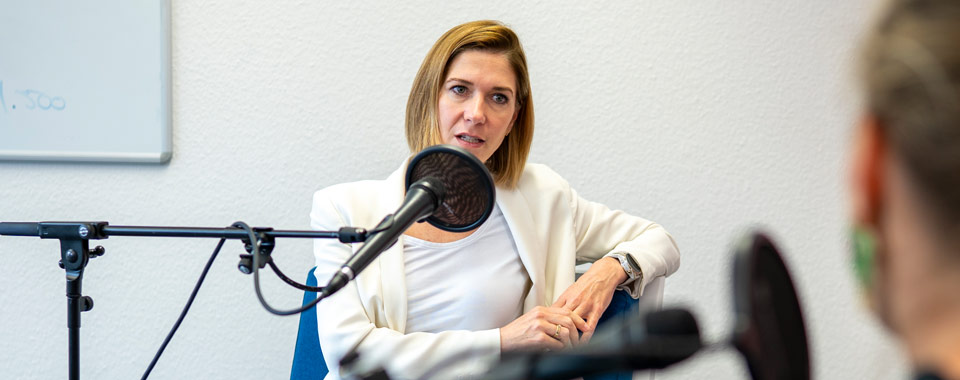
Lena-Sophie Müller
What are some use cases you personally find compelling?
I imagine every parcel courier would welcome not having to climb to the top floor of the same building several times a day. And I’d be quite happy if “someone” could return my parcels automatically. But of course, there are far more exciting areas of application. With climate change, wildfires have become a pressing issue—one that’s already pushing emergency services to their limits and putting lives at risk across the globe. Autonomous robots could make a real difference here. At worst, a robot might be damaged—but no human lives are lost in the effort to protect people and the environment.
You’re talking about major upheavals. Are we even ready for that?
63 per cent of people in Germany now feel well prepared for the digital transformation, but there are significant differences depending on education level and age. That’s why it’s difficult to give a clear answer. People are generally open to new technologies and developments—provided they offer personal benefits, are easy to use, and inspire trust. When it comes to Physical AI, however, there’s still limited exposure.
How do we broaden the scope? In other words, how can we understand digitalisation as a task for society as a whole?
We’re working to shift Germany’s often infrastructure and technology-focused debates into the context of everyday life, so that the benefits become more tangible. That means we need to look closely at specific use cases—and also consider the knock-on effects they may trigger, both in the short and long term. For example, how they might affect our tax system, social security structures and much more. Much of the government’s revenue today is still tied to human labour, but Physical AI will change that dynamic. And that raises the question of how we’ll fund our public services in future. To answer the question directly, public administration plays a crucial role, because it will determine whether people encounter Physical AI in their everyday lives. Authorities are the ones who must approve the use of these systems in our parks, institutions and on our streets. We need to build knowledge and understanding in this area and one way to do that is by creating real-world spaces where people can interact with Physical AI. Not in labs, but out in the world, so that people can encounter robots more frequently and naturally.
Connecting the physical and digital—that brings us back to Physical AI. What does this technology mean for Germany as an industrial nation?
Physical AI presents a major opportunity for Germany—both for society and for its industrial sector. First of all, when we think about the physical components—robots, drones, vehicles, machines of all kinds—they need to be manufactured, and historically, that’s something Germany has excelled at. Then comes the AI. These applications won’t rely on traditional large language models, but rather on specialised AI. This AI needs to be developed and trained in real-world environments. These are scalable solutions we could export globally. We could take a leading role and help shape what emerges—a new kind of support infrastructure, along with new skilled professions. We have the opportunity to build entirely new innovation ecosystems.
What role does politics play in all this?
It must create space for innovation and remove unnecessary barriers. If viable business models can be developed without roadblocks, more venture capital will flow—especially into start-ups. And skilled professionals will naturally follow. Policymakers need to put the right structures in place to make Germany attractive—for both talent and investment and we need to act quickly, because AI is already showing signs of a winner-takes-all dynamic. Those with access to data, computing power and scalability will dominate the market. Entering later will be difficult—if not impossible.
Initiative D21.
Initiative D21 is Germany’s largest non-profit network for the digital society, bringing together stakeholders from business, politics, academia and civil society. Since 1999, D21 has been shaping digital transformation in the public interest—aiming not only to highlight the current state and challenges of digitalisation, but also to develop and support the implementation of concrete, forward-looking solutions.
About Lena-Sophie Müller.
Lena-Sophie Müller is CEO of the non-profit Initiative D21 e.V., a leading expert on digital transformation and a frequent speaker on digitalisation topics. Her particular focus lies in shaping the societal impact of digital change. Before joining D21, she worked as a researcher at the Fraunhofer Institute FOKUS in Berlin. She also served as an expert member of the German Bundestag’s Enquete Commission on Artificial Intelligence from 2018 to 2020.