Villeroy & Boch – “Tradition is our greatest asset in the digital age”
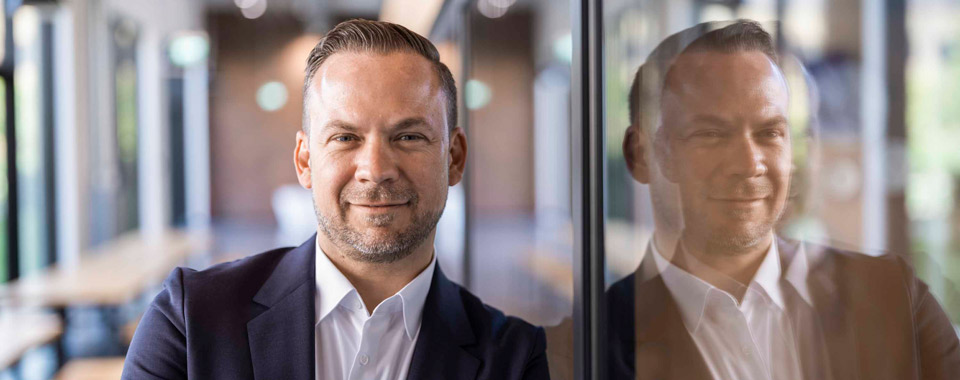
Dr Peter Domma, Chief Digital Officer (CDO) at Villeroy & Boch, is responsible for digitalisation and IT. In this interview, he shares how he is steering the heritage brand towards a digital future, the challenges and opportunities of acquiring a competitor of equal size, why he’s not a fan of standardised training programmes, and how AI can help detect defective items.
Dr Domma, what does digital future-readiness mean to you?
Peter Domma: Digital future-readiness is, first and foremost, driven by technology. It’s about laying the foundations for success in digital transformation. One key aspect is choosing the right technologies to enable processes that are critical to success. Equally important is getting all employees on board as they need to be able to use the chosen technologies effectively. In fact, I believe this is the greater challenge.
What role does IT play at Villeroy & Boch?
A major one—though we’re still on the journey. For me, IT needs to be an integral part of the business. That means it can’t remain a specialist discipline; it has to permeate the entire organisation. But that takes time, and we’ve seen this reflected in the waves of digitalisation over the past few years.
Where is digitalisation already playing a key role?
Our products aren’t the first thing that come to mind when you think of digitalisation—and that might actually be to our advantage. Still, from the very beginning, our digital strategy has looked at every part of the value chain—from procurement and production through to sales.
Can you give us some more details ...
In production, we started early on to work more intensively with data to explore how it—especially in combination with artificial intelligence—can help us become more efficient and improve quality. In sales, it goes far beyond e-commerce, whether in our own online shop or on external platforms. Here, it’s primarily about digital customer communication.
For me, IT needs to be an integral part of the business. That means it can’t remain a specialist discipline; it has to permeate the entire organisation.
Dr Peter Domma
What role do data and AI play in production?
We use image recognition to identify defective items very early in the process—saving us real money in both procurement and production because we can stop processes sooner. A plate won’t continue down the line if it’s flagged as faulty. This also helps us work more sustainably by reducing resource consumption. The AI models aren’t generic; we train them ourselves because they need to know exactly what constitutes a defect on a Villeroy & Boch plate, so developing our own AI capabilities is a key part of our strategy.
And in other areas of the business?
We’ve developed an internal, intelligent, GDPR-compliant chatbot that employees can use. It writes summaries, assists with translation tasks, and much more. Beyond that, we use AI extensively to generate text and images for our online shops, marketing, and communications. Here too, we’ve trained the AI to create content specifically tailored to the Villeroy & Boch brand.
Since 2024, you’ve faced another IT challenge: Villeroy & Boch acquired Ideal Standard, a competitor of roughly the same size …
That’s certainly kept us busy. The initial discussions were along the lines of “this IT landscape or that one, these applications or those. Which is better?” It quickly became clear that we needed clear guidelines, but the principle remains the same: we need the best solution for the newly merged company. Sometimes that’s Villeroy & Boch’s system, sometimes Ideal Standard’s, and sometimes an entirely new third option.
Does this also present an opportunity?
Absolutely, because this situation is unique. It gives us the chance to rethink, challenge assumptions and find new solutions.
But it hasn’t all gone smoothly …
Of course, there were moments when we thought: “We’ve spent years harmonising and standardising, and now we’re starting over.” Then new requirements emerge that cast previous decisions in a different light. That can be challenging.
How do you manage such a complex process?
By focusing on the strengths of both companies and identifying what works well and fits the business model. There’s no room for personal preferences like: “I’d really like to keep using this particular established solution.” That’s not productive. The most important element in this process is openness to new solutions.
And you also have to get 6,000 new colleagues on board …
We recently discussed this in a strategy meeting on AI. There’s a scientific model from 1985—Davis’s Technology Acceptance Model—that explains why technology is adopted and used. It highlights two key factors: perceived usefulness and perceived ease of use. In other words, how useful something is and how easy it is to use. Admittedly, the model is a bit dated, but it still applies today, whether we’re talking about integration tasks, software or AI.
And surely there are standard training sessions?
I have an aversion to standardised training. They achieve far less than we think. Users need to experience tools and platforms for themselves. That’s how fears are overcome, use cases and benefits become clear, and trust is built.
So no training, but hands-on experience …
… and transparency. As part of revising our digitalisation strategy, we set up a Programme Management Office to connect initiatives, allocate resources more effectively, set priorities and create transparency—not as a monitoring body, but as a steering function.
What’s the benefit for employees?
First of all, it gives us a clear framework for how projects are managed and organised—always using the same methodology. No one has to worry about that anymore. Who needs to be involved? What does a status report look like? These questions are clearly answered for everyone, meaning we can focus more on getting things done. And everyone has full visibility into what’s going on.
So the foundation is in place, but where is Villeroy & Boch’s digital journey heading?
One thing is for sure, AI is changing a lot, if not everything. If we think of the digital transformation as a series of waves, the next one is going to be big and powerful. We are continuing to invest early and push projects forward even if they won’t deliver ROI in six months, but only after a few years. That’s something we do differently from others, thanks to the strong support of our management and founding families. They understand the long-term nature of these measures, which allows us to act with real consistency.
You mentioned the founding families. Does such a strong tradition ever hold you back?
On the contrary—it’s our greatest asset. Tradition doesn’t mean clinging to the past. Villeroy & Boch has been learning for 277 years and has consistently evolved to succeed and stay successful. That deep-rooted awareness is something we draw on in our digital transformation journey.

Dr Peter Domma holds a degree in business administration and earned his doctorate at Saarland University. As Chief Digital Officer (CDO), he is responsible for the Digitalisation and IT division on the Executive Board. He joined Villeroy & Boch in 2016 as head of the then Online Unit. His career began at the insurer, CosmosDirekt, before moving to Generali Deutschland AG, where he was ultimately responsible for online marketing.
Villeroy & Boch is one of the world’s leading premium brands in the Dining & Lifestyle and Bathroom & Wellness segments. Founded in 1748 and headquartered in Mettlach, Germany, the company stands for innovation, design and quality. With its two core brands, Villeroy & Boch and Ideal Standard, the Group employs some 12,000 people and operates in approximately 140 countries worldwide.