Virtual worlds for the public sector.
Virtual worlds never went away, but they have now reached a level of maturity where they deliver real, practical value. Riding in the slipstream of the AI hype, extended reality (XR) has evolved into a technology that is proving especially useful in the public sector.
In the winter of 2021/22, virtual worlds were briefly hailed as the next big thing, but by spring, the media hype had already subsided. Just a few months later, artificial intelligence moved into the spotlight and has remained there ever since. As a result, virtual worlds faded from public attention, and expectations around them began to reset. With the hype behind them, extended reality technologies increasingly came to be judged not by grand visions, but by their practical usefulness. The focus shifted towards concrete applications and measurable benefits. As Dr Alexander Fink puts it: “In the shadow of the AI hype, virtual worlds have come of age, delivering practical solutions that enrich everyday life.”
The XR evolution.
Dr Alexander Fink is Head of Public Sector Innovations at Bechtle. Together with an expert team that includes Sophie Throm and Julian Leupold, he has been working for years on the question of how XR applications can deliver real value in schools, universities, hospitals and public authorities. “The public sector is particularly interesting because it affects all of us. This is where very different expectations and needs come together,” he explains. Why, then, has virtual reality not yet become part of everyday life? In Alexander Fink’s view, this is not due to a lack of interest, but to very practical constraints. For a long time, devices were too expensive, too heavy to wear for extended periods, and the available content was not yet mature enough.
Those three factors have changed significantly in recent years. XR headsets are now lighter, more affordable, easier to use and are increasingly supported by artificial intelligence. “Hardware and software have made enormous advances over the past few years, taking XR applications to a completely new level of quality,” says Alexander Fink. Just as importantly, the conversation around XR has changed. “Today, we are no longer talking about the colourful, fascinating worlds of three years ago,” Fink adds. “We are talking about concrete applications that solve real problems.”
Hardware and software have made enormous advances over the past few years, taking XR applications to a completely new level of quality.
Dr Alexander Fink, Head of Public Sector Innovations at Bechtle
Augmenting reality, not replacing it.
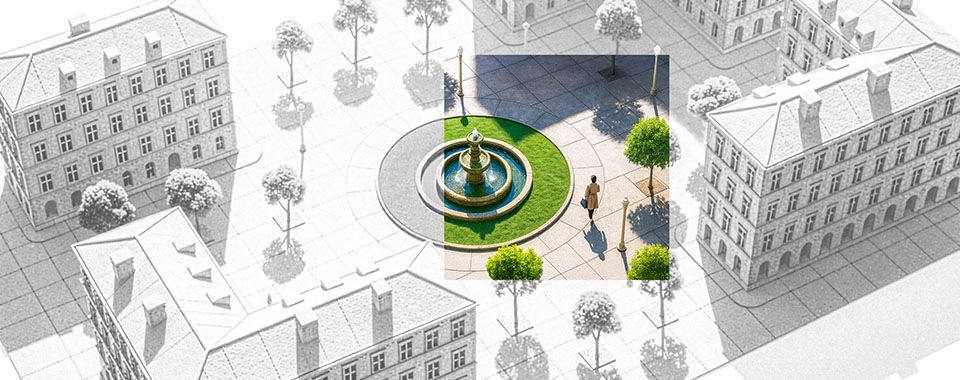
Extended reality—whether referred to as augmented reality, extended reality or simply XR—is an umbrella term for the technologies that make virtual environments possible. One of XR’s key strengths lies in its ability to make complex concepts easier to understand, which is particularly valuable when visualising things that do not yet exist, such as in urban and architectural planning. “What will a residential area look like once it’s built? That’s difficult to imagine from architectural drawings alone, but in a virtual environment, this is no longer an issue. Designs can be experienced and explored in three dimensions, making it much easier to understand a construction project and to ensure that all stakeholders are discussing the same concept,” adds Alexander Fink.
XR is not limited to future scenarios, however. Existing locations can also be captured digitally and explored virtually. One example can be found in the town of Schramberg, where citizens are able to visit an old bell tower that has been closed to the public for safety reasons. Virtual environments can also be used to simulate flood scenarios and test the effectiveness of protective measures in advance—an approach that can save lives in emergency situations. For the public sector, inclusion is another crucial aspect. In public authorities, virtual environments can help reduce language barriers, for example through the use of multilingual avatars that provide round‑the‑clock assistance with applications, answer questions and relieve pressure on staff. XR is also already addressing real, everyday challenges in the education sector.
Example from the education sector: Practising patient consultations in XR.
Medical students.
Medical students are well trained to explain medical conditions clearly and to make accurate diagnoses. However, when patient conversations become emotionally challenging, many struggle to respond confidently. While practice sessions with fellow students or professional actors are a common approach, they often fall short in practice because the situations rarely feel truly authentic.
An AI‑supported training system places students in a virtual consultation room, where they are faced with a digital patient avatar. Depending on the scenario, different patient profiles and medical conditions are presented. The conversations unfold realistically with the virtual patient responding to questions, reacting through facial expressions and gestures, and displaying a range of emotions—from anxiety to anger. This allows students to practise responding empathetically to sensitive situations in a safe environment, without pressure and without mistakes having immediate real‑world consequences.