
Digital Employee Experience.
“Nice to have” or a ROI-driven formula for success?
To attract and retain top talent, companies must make the digital workplace experience a priority and a strong Digital Employee Experience (DEX) strategy makes that possible.
DEX is the sum of all interactions employees have with their digital workplace, and it turns those experiences into measurable, actionable insights. Businesses that lead the way gain threefold: higher employee satisfaction and efficiency, a stronger position in the job market, and reduced costs and downtime that threaten productivity and success.

Why DEX belongs on the boardroom agenda.
DEX isn’t a feel-good topic you can take lightly. It’s a hard business metric. Smooth, consistent user experiences matter—from the first touchpoint on the careers portal to everyday collaboration tools. Analysts predict that by 2026, around 50 % of all digital workplace leaders will have implemented a DEX strategy. Ignore this shift and you risk losing relevance.
What happens when DEX is done right?
A positive DEX transforms the entire value chain: better recruitment, higher productivity, stronger collaboration, lower staff turnover and more. It also drives digitalisation, including the adoption of AI solutions. Process automation, AI, self-service tools and modern meeting spaces need clear frameworks and well-orchestrated platforms. Combined with proactive IT and a robust adoption and change strategy, companies achieve greater innovation, happier employees, lower recruitment costs and stronger retention—plus a significant boost in productivity and efficiency.

DEX isn’t a feel-good topic you can take lightly. It’s a hard business metric. Smooth, consistent user experiences matter—from the first touchpoint on the careers portal to everyday collaboration tools. Analysts predict that by 2026, around 50 % of all digital workplace leaders will have implemented a DEX strategy. Ignore this shift and you risk losing relevance.
A positive DEX transforms the entire value chain: better recruitment, higher productivity, stronger collaboration, lower staff turnover and more. It also drives digitalisation, including the adoption of AI solutions. Process automation, AI, self-service tools and modern meeting spaces need clear frameworks and well-orchestrated platforms. Combined with proactive IT and a robust adoption and change strategy, companies achieve greater innovation, happier employees, lower recruitment costs and stronger retention—plus a significant boost in productivity and efficiency.
By 2026, around 50 % of all digital workplace leaders will have implemented a DEX strategy.

What goals can DEX deliver on?
An effective DEX strategy starts with clear, measurable objectives. Self-service tools and front-loaded processes can cut Mean Time to Resolution and ticket volumes by up to 30%. Rigorous licence and application management can save up to €100,000 a year by eliminating unused seats, consolidating tools and leveraging real usage data in negotiations. In some cases, the savings could be even higher. Even more critical is the expected 59% reduction in downtime through proactive monitoring, telemetry and broad patch orchestration.
From silos to seamless flow.
Manual processes, disruptive screen-to-paper steps and missing interfaces slow businesses down, causing delays, errors and frustration. The fix is well known: integrated systems, modern client landscapes and proactive maintenance, but lasting impact only comes with consistent implementation. DEX brings every stakeholder together, creates synergies and ensures a unified flow across the organisation. A seamless experience boosts productivity and strengthens loyalty; and satisfied employees work with greater focus and less stress.

An effective DEX strategy starts with clear, measurable objectives. Self-service tools and front-loaded processes can cut Mean Time to Resolution and ticket volumes by up to 30%. Rigorous licence and application management can save up to €100,000 a year by eliminating unused seats, consolidating tools and leveraging real usage data in negotiations. In some cases, the savings could be even higher. Even more critical is the expected 59% reduction in downtime through proactive monitoring, telemetry and broad patch orchestration.
Manual processes, disruptive screen-to-paper steps and missing interfaces slow businesses down, causing delays, errors and frustration. The fix is well known: integrated systems, modern client landscapes and proactive maintenance, but lasting impact only comes with consistent implementation. DEX brings every stakeholder together, creates synergies and ensures a unified flow across the organisation. A seamless experience boosts productivity and strengthens loyalty; and satisfied employees work with greater focus and less stress.
Digital Employee Experience doesn’t happen by chance: technology and strategy are the drivers for measurable results.
Raimund Bernhardt‑Meisl, Head of the Digital Employee Experience Competence Centre

Effortless productivity.
Nothing derails a workday like unstable Wi-Fi, sluggish updates or outdated tech. Modern workplaces rely on automation, self-service and clean interfaces, and new ways of working fit right in: AR glasses support remote maintenance, training and complex design, while immersive meetings and collaboration tools take employee experience to the next level. From room design to operations, meetings evolve from a tedious obligation into a productivity driver.
Can you measure DEX?
Yes! And it’s essential that you do. A well-thought-out strategy follows a cycle: Measure → Assess → Set goals → Implement.

Nothing derails a workday like unstable Wi-Fi, sluggish updates or outdated tech. Modern workplaces rely on automation, self-service and clean interfaces, and new ways of working fit right in: AR glasses support remote maintenance, training and complex design, while immersive meetings and collaboration tools take employee experience to the next level. From room design to operations, meetings evolve from a tedious obligation into a productivity driver.
Yes! And it’s essential that you do. A well-thought-out strategy follows a cycle: Measure → Assess → Set goals → Implement.
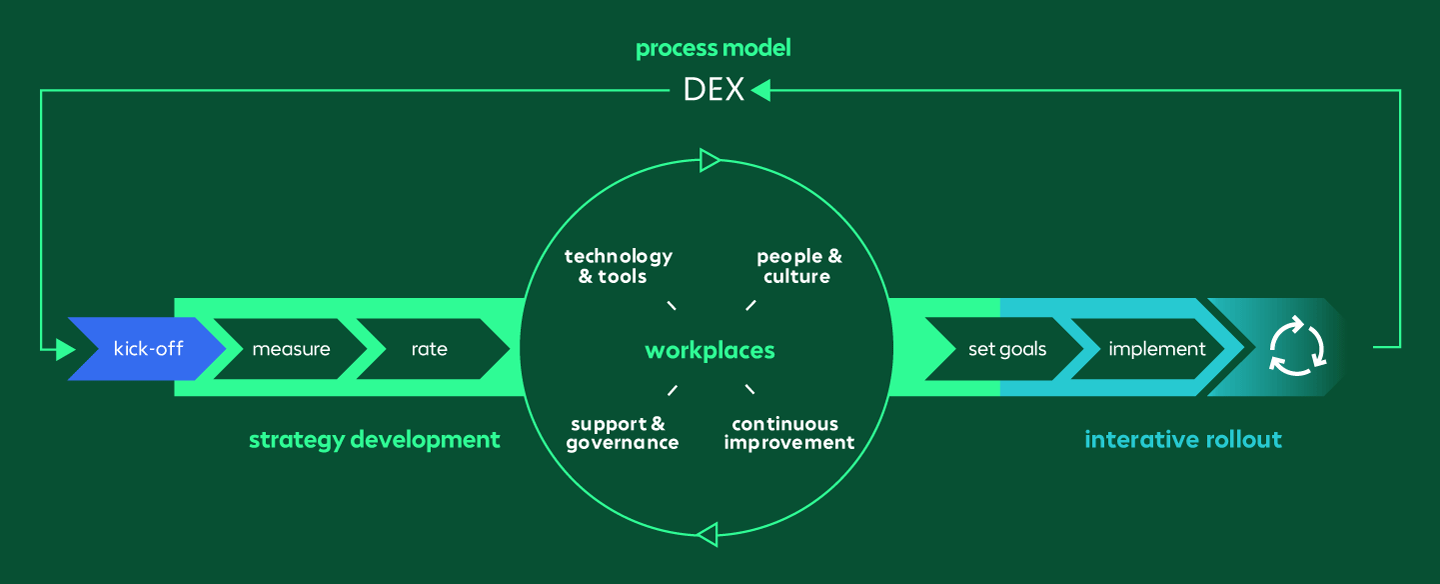
With eNPS surveys, pulse checks and tech-enabled DEX platforms, employee satisfaction becomes measurable in a GDPR-compliant way. These tools reveal adoption and downtime, delivering a tangible DEX score. Data turns into actions, driving continuous improvement and DEX becomes part of everyday management, not something that gets pushed to the back of everyone’s minds.

Are we ready for DEX?
To help you find out, we’ve developed the DEX + Workplace Maturity Model—a strategic tool to assess and advance your digital workplace, from benchmarking and roadmap planning to implementation and governance. It shows where your organisation stands and defines clear success indicators and measures for each stage, resulting in a prioritised roadmap to DEX maturity and a clear view of which technical and organisational changes deliver the greatest impact.
How to get started with DEX.
Companies that invest in DEX create measurable value—for their people and their business. To make it happen, it pays to work with an experienced partner. We offer a wide range of DEX services designed to make modern workplaces more efficient, productive and user-friendly.

To help you find out, we’ve developed the DEX + Workplace Maturity Model—a strategic tool to assess and advance your digital workplace, from benchmarking and roadmap planning to implementation and governance. It shows where your organisation stands and defines clear success indicators and measures for each stage, resulting in a prioritised roadmap to DEX maturity and a clear view of which technical and organisational changes deliver the greatest impact.
Companies that invest in DEX create measurable value—for their people and their business. To make it happen, it pays to work with an experienced partner. We offer a wide range of DEX services designed to make modern workplaces more efficient, productive and user-friendly.
Our practical playbook is the perfect starting point, covering everything you need to know about the Change Management Office, employee experience readiness, future skills and competencies—and how to kick-start your DEX journey. (This document is only available in German.)