

Why Product Lifecycle Management is essential for businesses of every size.
As product development grows ever more complex, with design, manufacturing, service and customer expectations more closely interconnected than ever before, simply creating good products is no longer enough. Success depends on how effectively, transparently and reliably every stage is manage—from the first idea through to the end customer. Product Lifecycle Management (PLM) goes far beyond a buzzword; it provides the foundation for creating innovative, dependable and commercially successful products.
Then get in touch! Our experts are happy to help.
PLM stands for Product Lifecycle Management—a holistic approach to managing and orchestrating all information and processes that arise throughout a product’s lifecycle. It spans everything from initial ideas and early sketches through design and manufacturing to delivery, service, and ultimately recycling or reuse. Uwe Burk, Executive Vice President at Bechtle Systemhaus Holding AG, puts it this way: “For us, PLM encompasses the entire value chain throughout the product lifecycle—from the initial idea through to operation or recycling, depending on the product category.” In practice, this means PLM ensures that the right information is available at the right time and in the right place—empowering teams across design, manufacturing, logistics, service engineering and many other roles to work seamlessly together.

PLM for SMEs – Why smaller organisations stand to gain.
The perception that PLM is only relevant for large enterprises still persists, but in reality, small and medium-sized businesses face the very same challenges as industry leaders—growing product complexity, ever-shorter development cycles and rising demands for documentation and traceability. Burk highlights this with the example of documentation overload: “In a typical development process, a vast number of documents are generated. When you consider how many components go into something like a vehicle transmission—or even lifestyle products such as wristwatches—it becomes clear that each individual component generates extensive documentation of its own. Managing this flood of data, including all its interdependencies, is a significant challenge.” Without structured processes, maintaining control over this information and ensuring quick access to the latest versions becomes unmanageable.
The real value of a PLM system becomes especially clear when changes need to be made at short notice. It automatically identifies all affected components and ensures that every required step—along with the underlying design intent—is fully documented and traceable. The result is fewer errors, reduced rework costs and the confidence that every decision is based on up-to-date data. For mid-sized businesses, PLM ultimately delivers one key advantage: greater security and efficiency in day-to-day operations. Teams make faster decisions, collaborate more seamlessly and benefit from smoother coordination across departments as well as with external partners.
PLM delivers measurable value by bringing clarity and structure to growing complexity. Instead of managing data across scattered folders, disconnected systems or even individual knowledge silos, a central platform creates a single source of truth that ensures full transparency across the organisation. With everyone working from the same, up-to-date data, potential errors are reduced while overall quality is significantly improved. In addition, standardised workflows for approvals, changes and reviews accelerate processes and remove unnecessary friction. Whether identifying when a component was last modified or who signed off a release, critical information is instantly available—no time-consuming searches required. At the same time, built-in documentation and traceability make it far easier to meet regulatory requirements with confidence. PLM also unlocks the ability to reuse proven components and modules, reducing development effort and shortening time to market for new products. The result is a faster pace of innovation combined with the assurance of consistently high quality and reliability—giving businesses a decisive competitive edge.
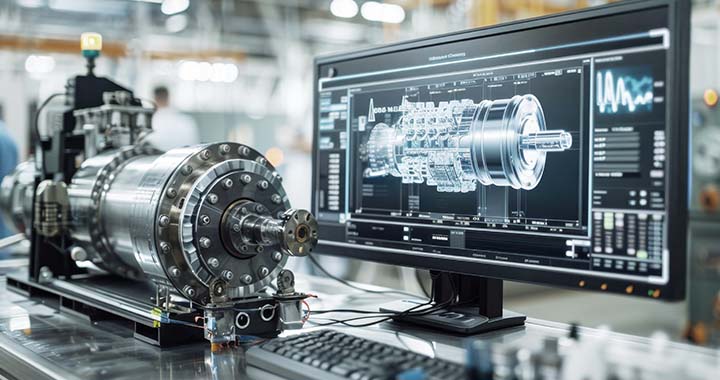
PLM provides the essential foundation for keeping a digital twin alive.
Uwe Burk, Executive Vice President Bechtle Systemhaus Holding AG
One particularly interesting area is the digital twin—a virtual representation of a product that is maintained throughout its entire lifecycle. Without PLM, this approach would not be possible, as only the consistent linking of all product information ensures that the digital twin remains up to date and reliable. Burk puts it succinctly: “PLM provides the essential foundation for keeping a digital twin alive. Within PLM, we ensure that every component and every attribute of a product is linked to the development chain. This makes it possible to map even small changes and their impact on production.”
This makes it clear that PLM forms the basis on which technologies such as virtual simulations, predictive maintenance and the use of artificial intelligence can function. For mid-sized companies, this opens up new opportunities—for example, by identifying errors in a virtual environment before they occur in real production. As a result, prototype costs are reduced, development cycles are shortened and innovations reach the market more quickly.

PLM as a process – Platform solutions vs modular approaches.
It is important to understand that PLM is, first and foremost, a process, which can be supported in two ways—either through an integrated platform or through a combination of components that form a tailored solution. Uwe Burk explains: “At Bechtle PLM, we offer both approaches. Our main partner is Dassault Systèmes with the 3DEXPERIENCE platform, which integrates authoring systems, change and approval processes, configuration management and more.” At the same time, many customers start with a lean product data management (PDM) solution, for example, to manage mechanical components and assemblies and to ensure consistency across product documentation. Burk adds: These solutions can be gradually expanded to include additional disciplines such as electrical engineering, electronics or simulation.”
The cloud option is particularly attractive for small and medium-sized businesses: as Software-as-a-Service solutions eliminate the high upfront investment often required for on-premise systems, significantly lowering the barriers to entry and making PLM more accessible. Even companies with limited resources can benefit without incurring high IT infrastructure costs. At the same time, Bechtle PLM ensures that its cloud offering goes beyond software, supporting implementation, customisation and operation as an integration and consulting partner.
We cover our customers’ entire value chain—from early development through to operations and service management.
Uwe Burk, Executive Vice President Bechtle Systemhaus Holding AG
Before implementing a PLM system, companies often face similar situations: data is spread across different systems, changes are difficult to track and much of the knowledge resides in employees’ heads rather than in documented processes. This leads not only to inefficiency, but also to a higher risk of errors or failures. Bechtle PLM addresses exactly these challenges. “We cover our customers’ entire value chain—from early development through to operations and service management,” emphasises Burk. This means it is not just about introducing software, but about designing efficient processes, integrating them into existing IT landscapes and building knowledge within the organisation.

Why Bechtle PLM?
Bechtle PLM combines many years of experience with a clear focus on the needs of SMEs. Customers benefit from a consulting approach that goes beyond technology to equally address processes, organisation and change management. Flexibility is a key advantage as it allows companies to start small and scale step by step without being tied to rigid solutions. At the same time, Bechtle PLM has the expertise to deliver even complex projects on integrated platforms—in the cloud or on-premise.
Uwe Burk summarises: “Of course, we know our partners’ solutions inside out, especially those from Dassault Systèmes. At the same time, we have our own development capabilities, so we can adapt solutions to fit our customers’ infrastructure—from simple configuration right through to custom development.” This goes to show that Bechtle PLM is not just a software provider, but a partner working closely with its customers to deliver tailored solutions.
Conclusion – PLM as a competitive advantage for businesses of every size.
PLM is not a luxury for large enterprises, but a necessity for any company developing, manufacturing and supporting complex products. It ensures transparency, quality and efficiency across the entire product lifecycle while providing the foundation for future technologies such as digital twins and AI. For small and medium-sized businesses, PLM offers the opportunity to achieve significant improvements with manageable effort including fewer errors, shorter development cycles and stronger competitiveness. With a partner like Bechtle PLM, combining experience, technology and consulting, this opportunity becomes a practical solution, and complex challenges become a clearly structured, future-ready process.
Get in touch for a no-strings-attached consultation.
Our broad portfolio of solutions and services across engineering, manufacturing, business consulting and training makes us a flexible PLM solutions provider that strengthens our customers’ ability to innovate and supports them in becoming more agile.
You might also be interested in:
From sensors to managed services, we provide everything you need for your IoT initiatives. Learn more in our article.
AIoT combines IoT data with AI, thereby automating processes. This is a game-changer for businesses. Find out more in our article.