“Making quantum computing practical”: Frank Schlichting on the mobile quantum computer from SaxonQ.
To accompany the latest episode of the Basis 108 podcast, we spoke with Frank Schlichting, Co-CEO of Leipzig-based quantum computing start-up SaxonQ. In the conversation, he explains how SaxonQ is rethinking quantum computing with room-temperature systems, why diamonds play a crucial role, and what enterprises should do today to prepare for the quantum era.
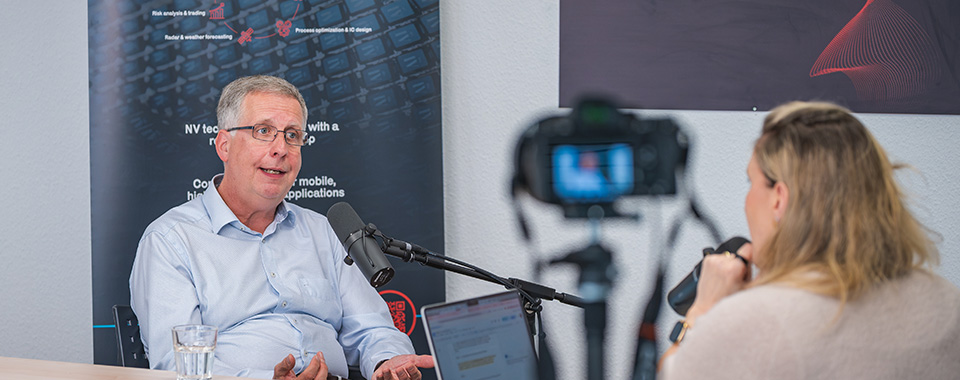
Dr Frank Schlichting is Co-CEO of the Leipzig-based quantum computing start-up SaxonQ and is responsible for the company’s strategic and operational development. A physicist and engineer with a PhD, he has many years’ leadership experience in the fields of semiconductor technology, communications technology and digital energy solutions. At SaxonQ, he is driving forward the development of practical quantum computers ‘Made in Germany’ – with the aim of translating cutting-edge technology into marketable applications.
Frank, when people hear the term “quantum computing,” they often think of huge, extremely cold laboratory set-ups. What makes SaxonQ different?
Frank Schlichting: This perception is understandable, as most quantum computers today rely on extremely complex cooling systems and operate close to absolute zero. At SaxonQ, we have taken a different approach. Our aim is to make quantum computing practical, mobile and energy-efficient. We have developed a quantum computer that operates at room temperature. Rather than requiring a specialised laboratory environment, our technology can be used under normal industrial conditions. Ultimately, we want to reduce the size of these systems even further and enable entirely new applications in fields such as robotics, autonomous driving and medical diagnostics.
Why is mobility such an important goal?
Many future applications of quantum computing will not take place in large data centres. They will be used in situations where decisions need to be made in real time and with limited energy resources. Think of autonomous vehicles or intelligent robots. These systems constantly process huge amounts of sensor data and have to make decisions immediately. You cannot attach a massive data centre—or a cryogenic cooling system—to a car. What is needed is highly efficient computing power that can be deployed directly where decisions need to be made. This is precisely the direction we are pursuing with mobile quantum computing.
Do your systems already have practical applications?
Yes. At the Hannover Messe, for example, we demonstrated a simple image recognition application. Visitors drew smiley faces, and our quantum computer identified them. This demonstration was not about developing the most advanced AI model. It was about proving three things: firstly, that there is a real quantum computer that can already be used today; secondly, that it works reliably in demanding environments such as trade fairs; and thirdly, that practical applications in the fields of artificial intelligence and image recognition are already possible. The underlying principle can be applied to far more complex use cases in healthcare, diagnostics, manufacturing and many other sectors.
SaxonQ’s technology is based on diamonds. What role do they play?
The diamond is, in fact, the key to our approach. We use specially engineered diamonds that contain what are known as nitrogen-vacancy centres (NV centres). These are tiny defects within the diamond’s crystal structure where a carbon atom has been replaced, creating a vacancy. The exceptionally stable crystal lattice enables us to control quantum states without the need for cooling, as is required by other quantum computing technologies. The diamonds themselves are very small—just a few millimetres in size—but they provide a remarkably stable environment for quantum operations. Put simply, they enable us to develop quantum computing systems that operate at room temperature.
How does this differ from conventional quantum computers?
The main difference lies in energy consumption and the complexity of operation. Many existing quantum systems require a complex cooling infrastructure and consume large amounts of energy simply to maintain operating conditions. Our approach eliminates this requirement. Currently, our systems consume around 600 watts, which is comparable to the consumption of a domestic appliance. However, even that is not yet the ultimate goal. We are continuously working on miniaturising the technology and aim to significantly reduce energy consumption in future generations. In the long term, we are aiming for compact quantum chips that can be integrated into a wide range of industrial systems.
Where do you see the greatest potential for application?
There are several exciting areas. One of these is healthcare. We have discussed use cases with medical experts where quantum-assisted image analysis could enable faster and more accurate diagnoses. In some cases, processing complex diagnostic data still takes days today. Our vision is to bring this capability much closer to the point of care. Another key area is artificial intelligence. AI models require enormous computing resources, and energy consumption is rising rapidly. Quantum technologies could help to solve certain classes of problems far more efficiently than conventional computer architectures. We also see considerable potential in autonomous systems, robotics, optimisation tasks, logistics, research into advanced materials and chemistry.
Cybersecurity is another issue frequently associated with quantum computers. Should businesses be concerned?
Organisations should certainly prepare for this. Many encryption methods currently considered secure could become vulnerable once sufficiently powerful quantum computers become available. For this reason, experts often refer to ‘harvest now, decipher later’ scenarios, in which encrypted data is collected today with a view to cracking it in the future. This does not mean there is cause for panic, but it does mean that companies should start exploring quantum-secure encryption strategies now. Sensitive information, intellectual property and critical infrastructure must all be assessed with long-term security in mind. At the same time, quantum technologies will not only bring new challenges for cybersecurity – they will also contribute to new solutions.
What role do partnerships play in the market launch of quantum computers?
They are absolutely essential. SaxonQ is a highly specialised technology company with a relatively small team. To drive adoption, we need strong partners who understand customer environments, integration requirements and operational processes. That is why partnerships with companies such as Bechtle are so important. It’s not just about sales. It’s also about expertise, implementation and helping customers understand how quantum technologies can add value within their specific business contexts. To make quantum computing practical, an ecosystem is required—comprising technology providers, software developers, research institutions and integration partners working together.
Finally: What advice would you give to IT leaders today?
There are three areas they should focus on:
Firstly: cyber security and quantum-safe encryption. Organisations should assess which information needs to be protected in the long term and evaluate their migration strategies.
Secondly: energy efficiency. Computing demands continue to rise dramatically, particularly due to AI. Every organisation should consider how future workloads can be managed sustainably.
Thirdly: quantum readiness. Companies do not need to become quantum experts overnight, but they should start by identifying potential use cases and understanding where quantum algorithms might offer advantages in the future.
The quantum age is no longer a distant vision. The companies that are preparing for it today will be best positioned to benefit from the technology once it matures.